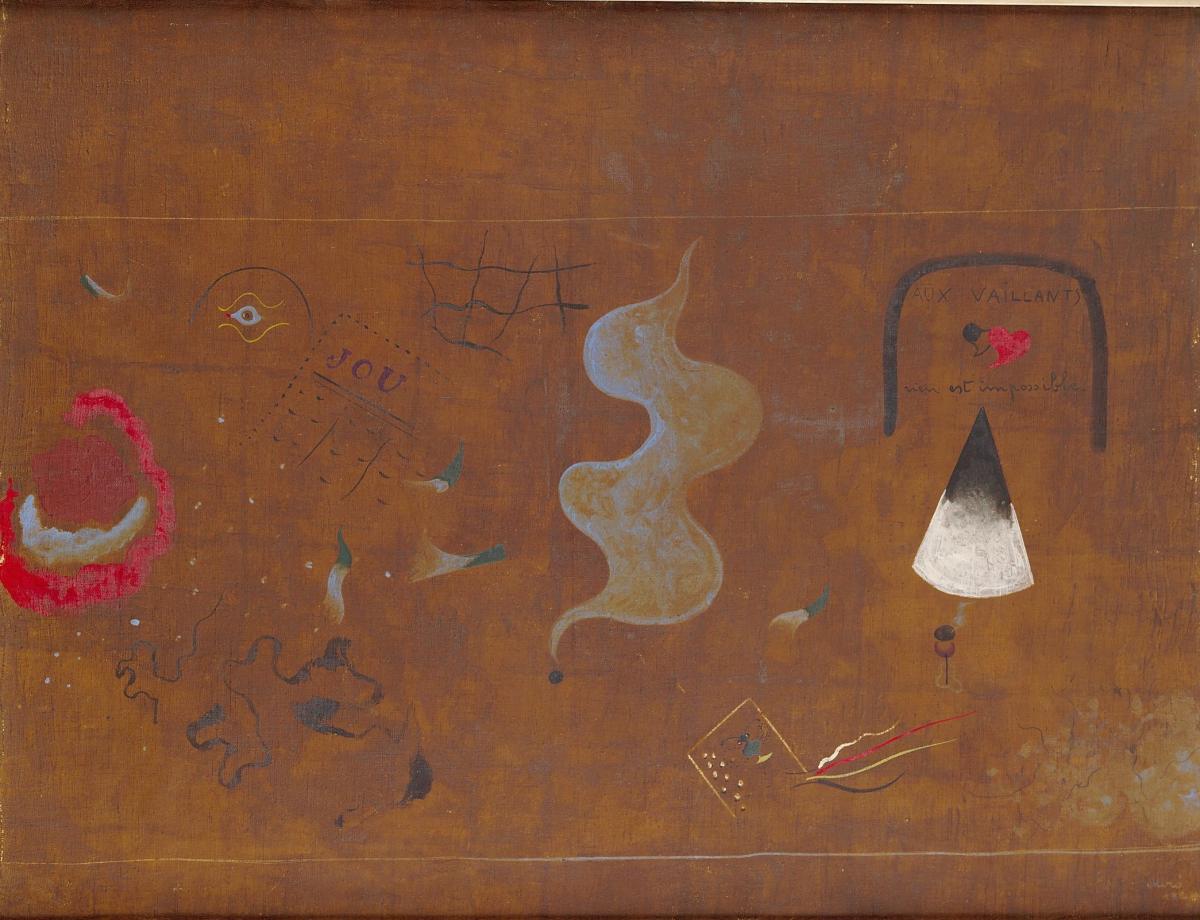
Deeply moved by his discovery of the Surrealists in Paris in the early 1920s, the Catalan painter and sculptor Joan Miró (1893–1983) abandoned the precise realism he had practised until then in 1924, turning instead to paintings imbued with dreamlike quality and mystery. *Head of a Smoker* bears witness to his first steps in this new phase of his artistic career, influenced by Surrealist innovations such as fragmentation and the juxtaposition of unexpected images. Miró thus offers the viewer a new, rather playful visual language, presenting a multitude of clues to be deciphered. In a composition reminiscent of cave art, various elements and traces float enigmatically against a brown background, with no apparent connection or narrative logic. Yet, taken together, they provide us with valuable clues as to the work’s symbolism. The artist echoes the ancient myth of the Minotaur, a creature half-man, half-bull, whose white horns with black tips are recognisable. The grid serves as a metaphor for the labyrinth in which the monster was imprisoned, whilst the winding black thread represents Ariadne’s thread, which enabled her and the hero Theseus to escape from this giant arena. The maxim ‘To valiant hearts, nothing is impossible’ pays tribute to their courage and love, in the form of a rebus depicting two intertwined hearts. This integration of writing into a painted work is part of the continuation of the Dadaist experiments with which Miró was well acquainted. This revolutionary artistic movement, which emerged in 1915, sought to overturn the traditional codes of art, much like Surrealism. It is worth noting that the myth of the Minotaur was particularly favoured by his friend Pablo Picasso and by the Surrealist movement, which would indeed use it as the title of a magazine from 1933 onwards. The Catalan artist’s work joined the collections of the Musée d’Ixelles in 1977 through a ‘happy accident’, a museum primarily dedicated to Belgian art. Credit for this goes to the Ixelles-based art dealer and collector Marc Janlet, who bequeathed several exceptional works, including another by Miró, *The Circus Horse* (1927).
This translation has been automatically generated by DeepL.