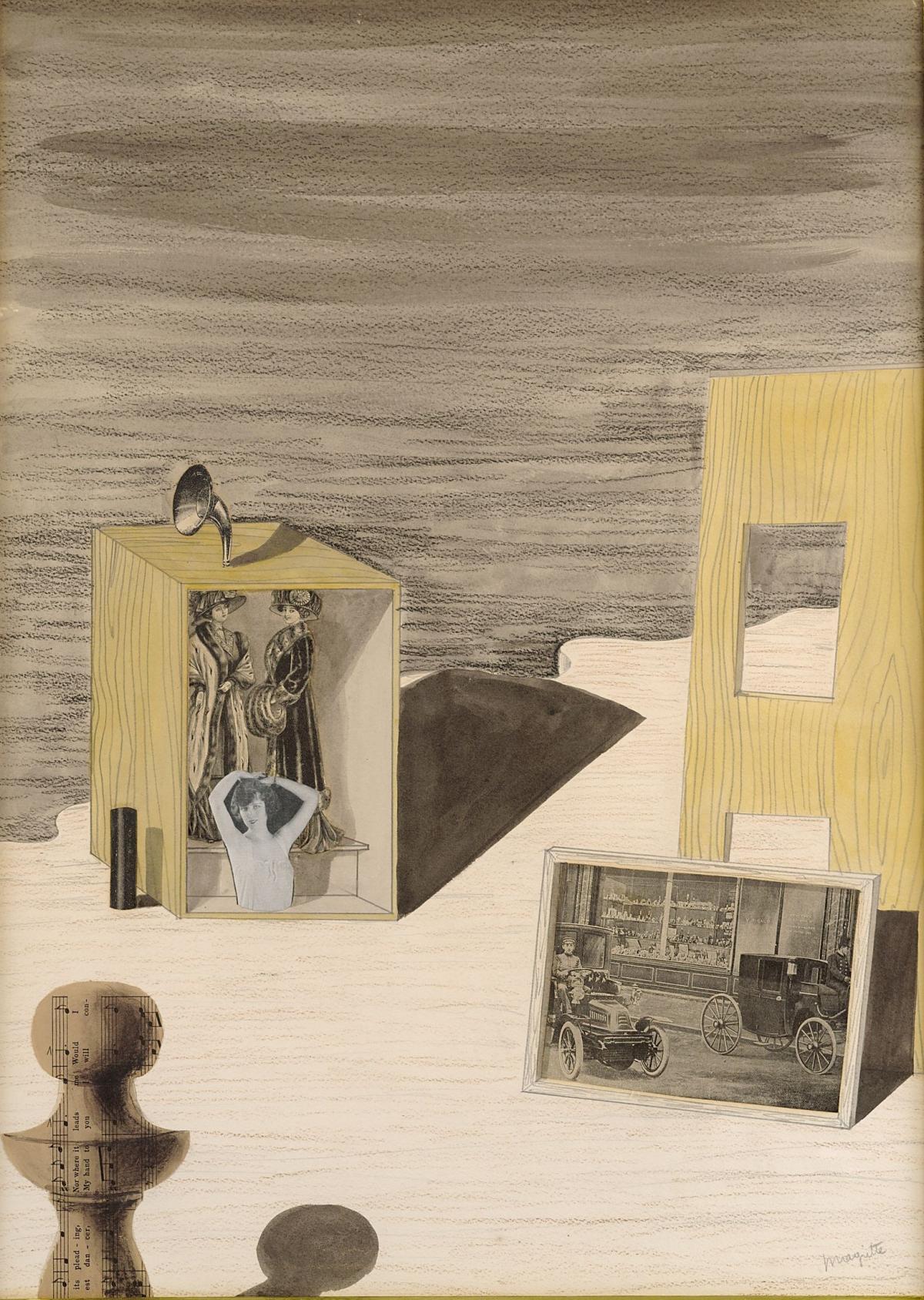
In the early 1920s, René Magritte’s friendship with artists associated with the Dada movement and his discovery of Giorgio De Chirico’s work in 1925 steered him definitively towards Surrealism. That year, he created his first collages, no doubt influenced by Max Ernst’s original collages. The artist produced around 24 of them until 1927, when he left for Paris. The typical motifs of ‘Magrittean’ style are already evident in these early works, such as the famous cup-and-ball game in the foreground. In a mysterious space, he juxtaposes cut-out photographs—such as that of a shop front—with drawn architectural elements, such as the box or the wall pierced with openings, which allow him to suggest perspective. Music appears to be a recurring element in this collage, with excerpts from sheet music pasted onto the cup-and-ball game in the foreground, but also through the mysterious phonograph, which has become a cube housing young women. The use of musical scores in his collages stems primarily from his professional practice (he illustrated the covers of sheet music) but is also undoubtedly a tribute to his friend E.L.T. Mesens, a poet and composer. But as always with Magritte, the meaning of the work eludes us, as the painter himself put it: ‘I take care, as far as possible, to produce only paintings that evoke mystery with the precision and enchantment necessary to the life of ideas.’
This translation has been automatically generated by DeepL.