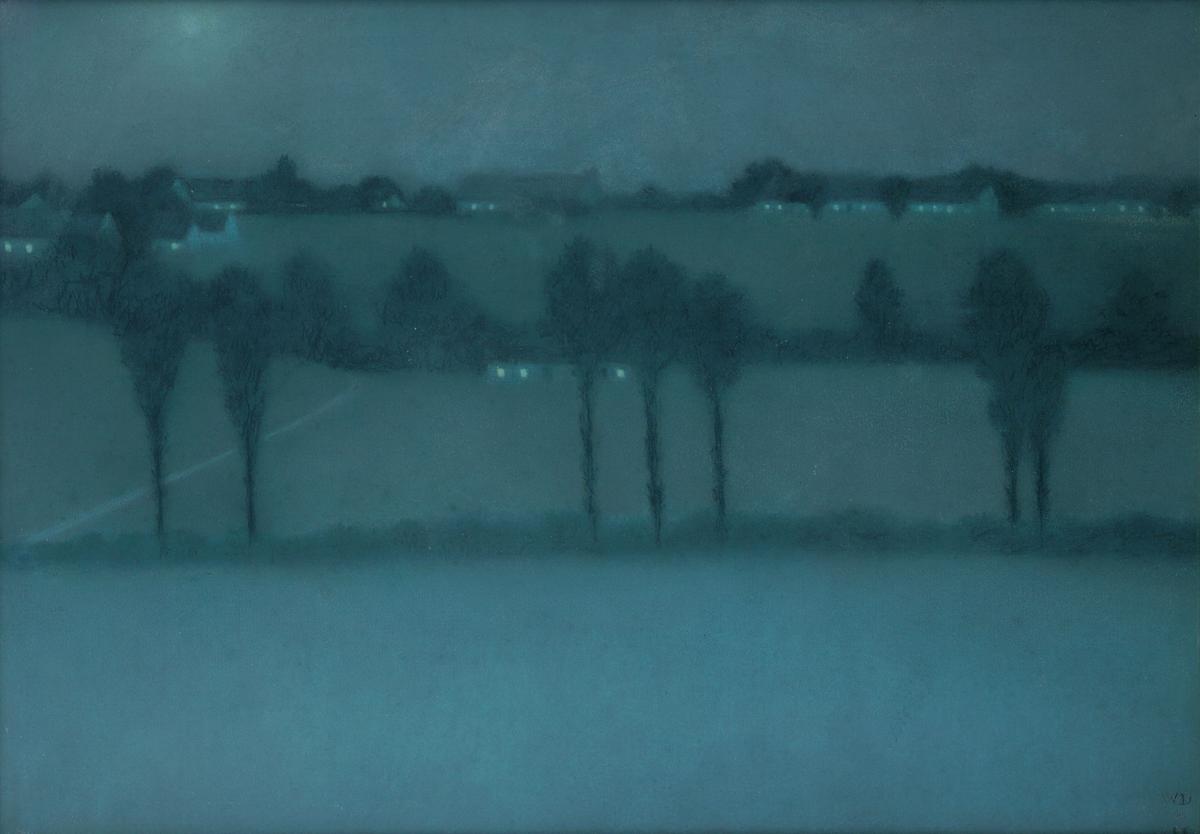
This *Night Scene* from 1896 is typical of the nocturnal scenes that were then occupying the artist William Degouve De Nuncques. In the late 1890s, the artist produced several views of plains, parks or forests, all monochrome as they are bathed in the same twilight. Whilst he occasionally included peacocks or swans in these scenes, Degouve favoured landscapes devoid of any figures. Here, human presence is merely suggested through the lights of the houses dotting what is likely the Brabant landscape, which Degouve enjoyed revisiting between his travels abroad. As the title suggests, however, the artist does not anchor his depiction in a specific environment. On the contrary, he seeks to transcend reality through the expression—both more personal and more universal—of an atmosphere as perceived by an individual. Through the blurring of contours, the nocturnal scene is employed as a poetic means of derealisation, as art historian Denis Laoureux has explained. The choice of pastel is significant in this regard: light and airy, pastel lends itself to evoking a vision shrouded in blue mist. Through such preferences, Degouve aligns himself with fin-de-siècle Symbolism, propagated in Europe notably by the Belgian avant-garde movements of the 1900s and the Libre Esthétique – indeed, the artist would later present this *Effet de nuit* to the leading figure of these movements, Octave Maus. Other artists creating nocturnes, such as the American James McNeil Whistler, gravitated around these circles. Degouve’s approach, however, differs from that of Whistler, whose nocturnes often spring from informal bursts of colour, whereas Degouve creates the evocative yet refined world of *Effet de nuit* through an almost Cartesian arrangement of horizontal and vertical lines. The artist summed up his approach as follows: “To paint a picture, one need only take some colours, draw some lines and fill the rest with feeling.”
This translation has been automatically generated by DeepL.