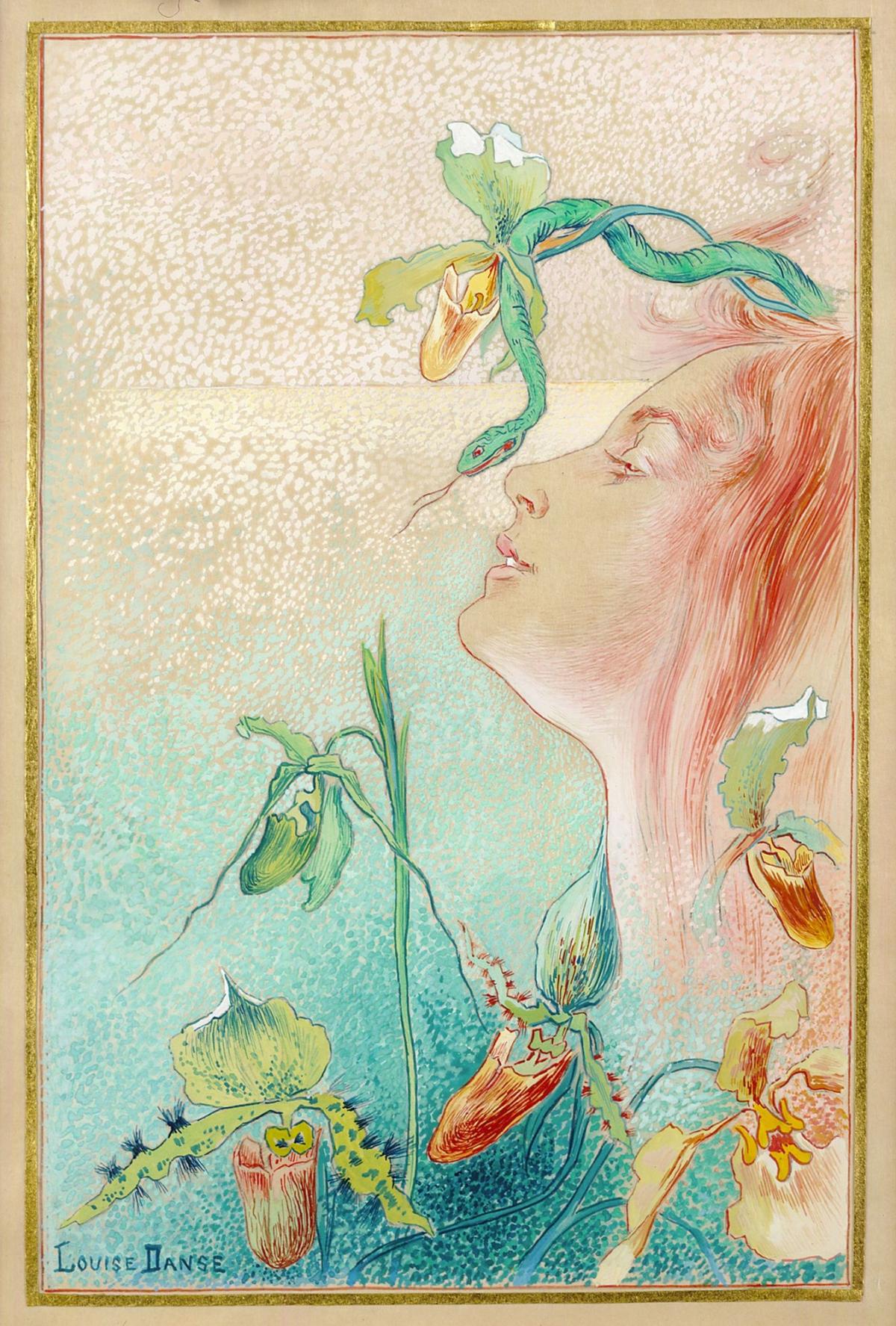
Louise Danse was trained in the arts by her father, the Brussels-based engraver Auguste Danse. A member of the Société des Aquafortistes Belges and the L’Estampe group, she left behind a body of drawings and engravings, including this watercolour, which was bequeathed to the museum by Octave Maus, a leading figure of the Belgian fin-de-siècle. Produced around 1900, Orchids is representative of the Art Nouveau style then in vogue. Celebrating organic forms, this movement suggests an osmosis between plants, animals and man – or rather, in the context of Art Nouveau, woman.As is often the case, Louise Danse depicts her subject in profile, so as to emphasise the sinuous line of her neck and face. With her head tilted back, her eyelids half-closed and her full lips, her expression is sensual and voluptuous. But the attentive viewer will notice a snake emerging from her skull, ready to spit its venom – could this slender figure be a Gorgon in the making? A contemporary critic, Judith Cladel, certainly recognises the emblematic femme fatale of the fin-de-siècle in Danse’s work, when she describes “these snakes (which) project their forked fangs towards the rosy lips of nymphs, sisters of Salammbô with their ingenuous perversity”. The snake coils around the stem of an orchid, an exotic plant also favoured by other Art Nouveau artists, such as Emile Gallé and Louis Majorelle. Its flowers invade the figure and nestle in her hair – flora and woman become one, in a ballet of undulating lines. The composition is highly decorative, an effect further heightened by the iridescent background of small orange and turquoise touches, and the inclusion of the watercolour within a pink fabric mat, complemented by an ornamental frame.
This translation has been automatically generated by DeepL.