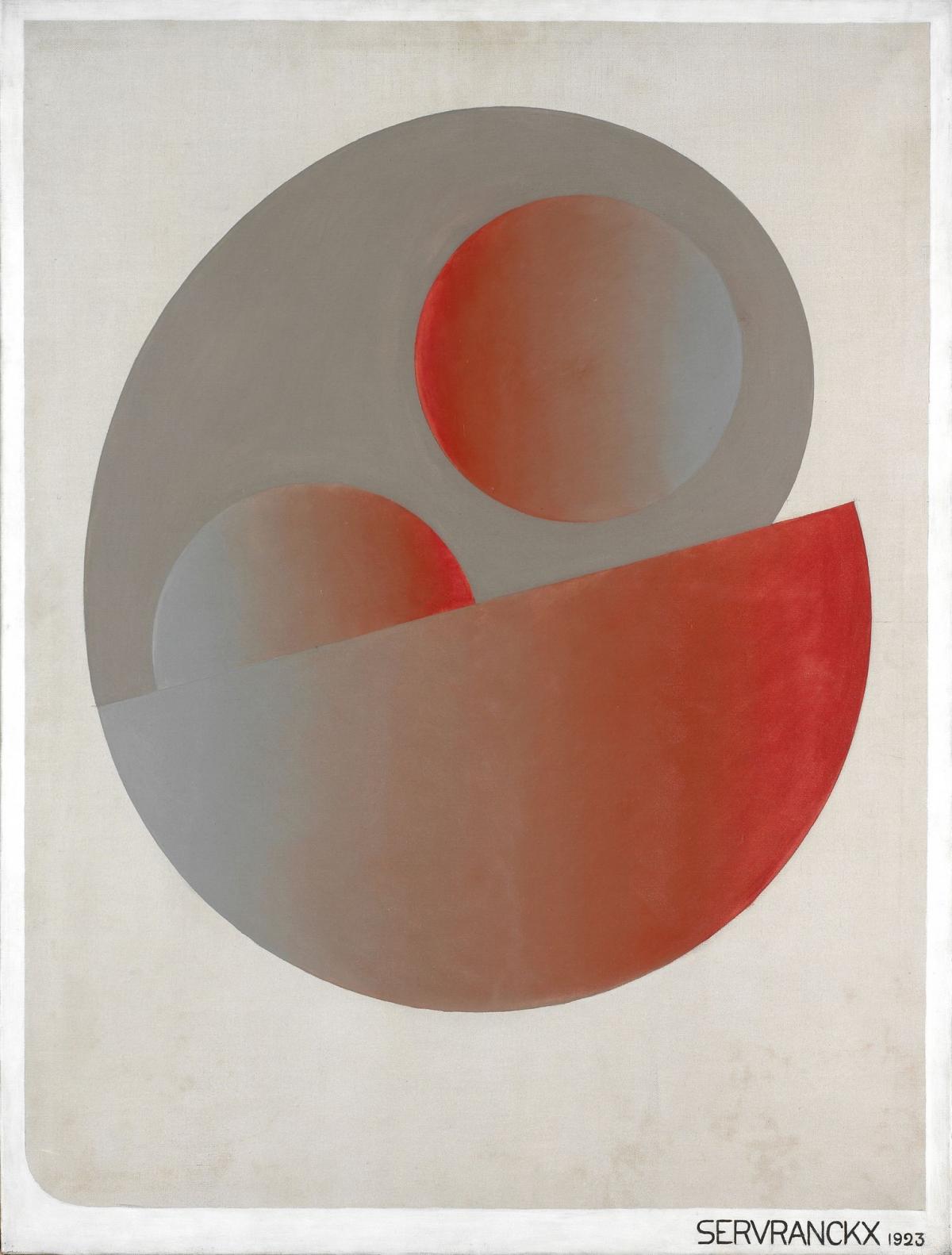
Against a gradient of grey and red, several circles—some whole, some halved—collide. One might see in it a painter’s palette, or planets clustered with their moons. The painting also evokes depictions of machines, such as those painted by Fernand Léger. It is, in fact, a purely plastic composition evoking the industrial world. The idea is no longer to draw inspiration from a real motif, but to create universal abstract art. When Victor Servranckx created Opus 53, so named as it was his 53rd work, he was just 26 years old. In the wake of the First World War, he reacted, alongside others such as Jozef Peeters and Prosper De Troyer, to the gentrification of painting. Like them, he aspired to ‘Pure Plastic Art’. The ideas of this small group of artists were publicised by the Belgian magazine 7 arts, whose first issue contained the manifesto of the Constructivist movement. It stated that ‘art is an active experience of civilisation’. The art they advocated was intended to be universal and understood by all, for, according to Servranckx, “Geometric laws are what connect people; they are the platform where all people can meet; they are common ground for a possible collective art. Geometric form excludes particularistic individualism…”.
This translation has been automatically generated by DeepL.