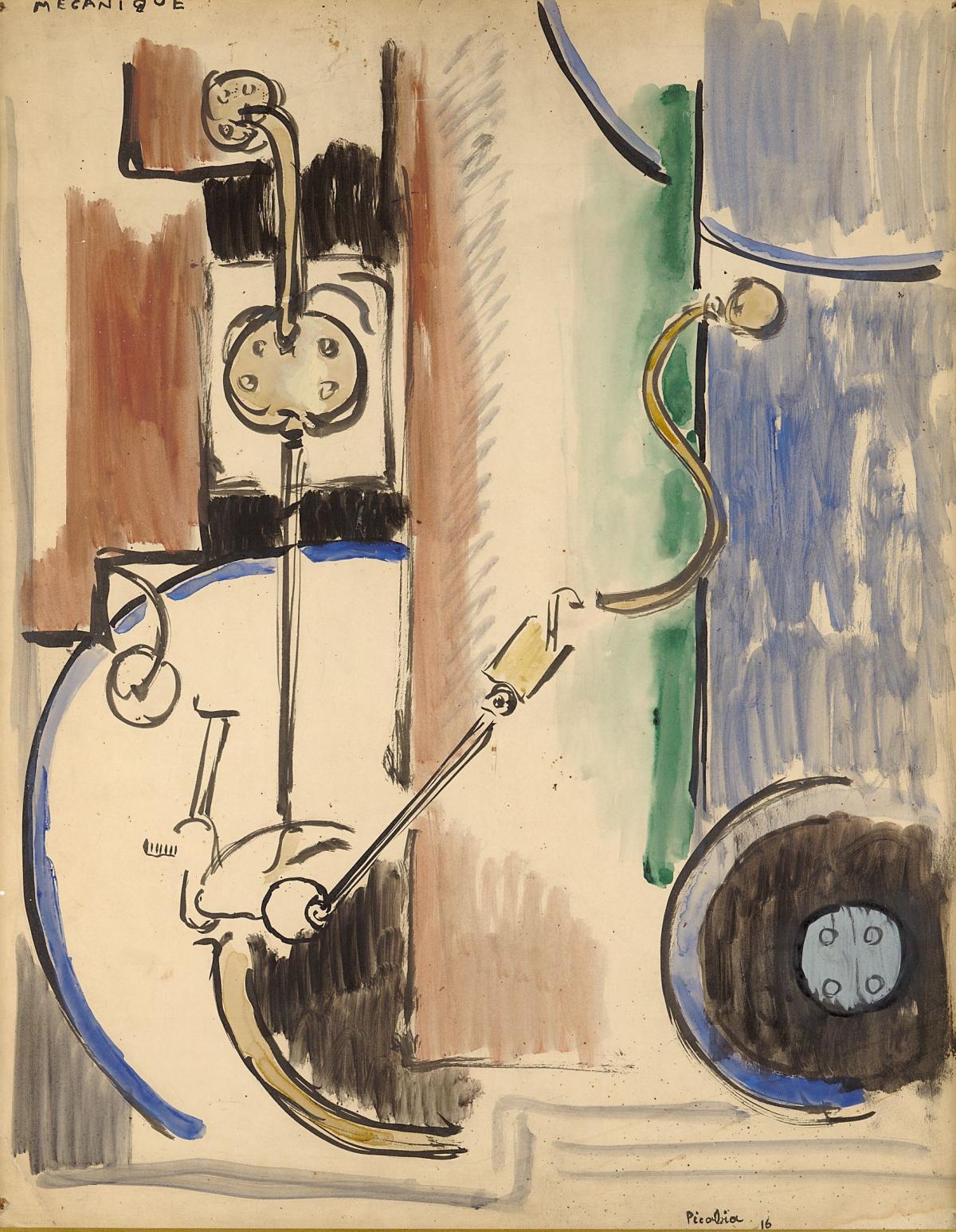
This work is part of Francis Picabia’s *Mécaniques* series. In it, he questions the supremacy of machines, and more specifically that of the automobile, which was all the rage at the time. Although Picabia was particularly devoted to the car (he owned 127 of them!), a certain spirit of derision towards the omnipotence of mechanisation championed by the Futurists is not absent from his work. His Mécaniques series already challenges traditional values, conventions, fashion and good taste, as well as the very legitimacy of painting.Marcel Duchamp, a very close friend of Picabia’s, wrote of him: “Throughout his 50 years as a painter, Picabia has consistently avoided adhering to any formula or being labelled. He could be called the greatest champion of freedom in art, not only against academic slavery, but also against the slavery of any dogma.”
This translation has been automatically generated by DeepL.