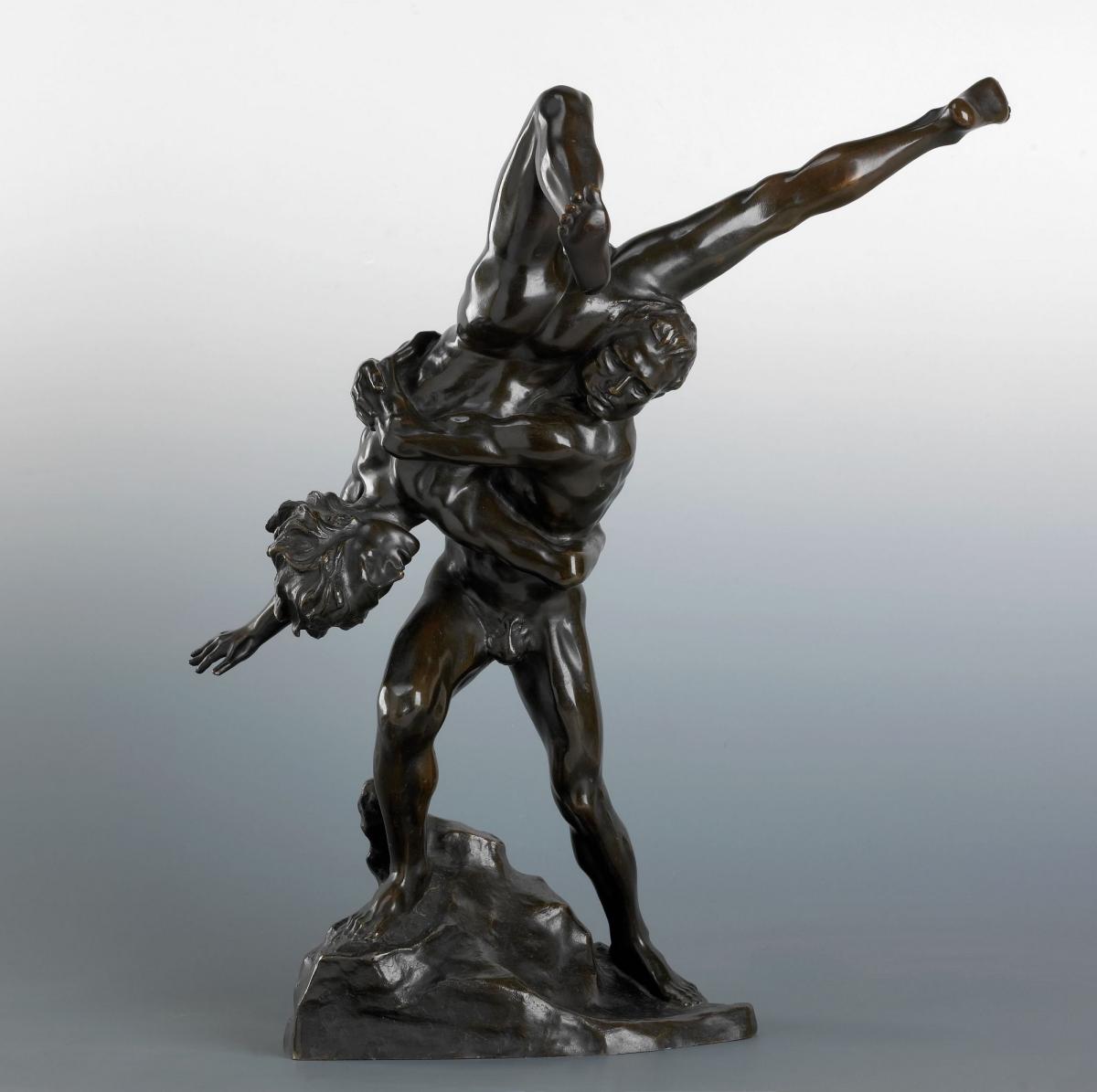
This bronze statuette was designed by the Belgian sculptor Jef Lambeaux, creator of the iconic Brabo Fountain on Antwerp’s Grand Place and the controversial monumental relief *Les Passions humaines* in Brussels’ Cinquantenaire Park. Here, Lambeaux explores one of his favourite subjects: muscular wrestlers locked in a grip – the wrestler on his feet has his opponent by the belt and is throwing him headfirst to the ground. During the 1880s and 1890s, Lambeaux created pairs of wrestlers in various poses and sizes. It was with a similar statuette that he exhibited at the first avant-garde Salon des XX in 1884, and his monumental-scale Wrestlers can still be found in public spaces today, from Antwerp to Laeken. Although wrestling already existed in antiquity, the sport enjoyed a resurgence of interest in the late 19th century as a fairground attraction, captivating both the public and artists. Regularly in the front row to observe the combatants, Lambeaux captured there ‘in the unpredictability of the action, admirable displays of musculature. In the bare, arched torsos, in the stiffening of the limbs, [he] discerns planes and lines of true beauty” (quoted in Edmond-Louis De Taeye). Drawing on models and sketches, the sculptor renders the tension of the bodies with great anatomical accuracy, emphasised by their nudity. The absence of clothing also lends them a timeless, even heroic quality, further heightened by the spatial setting confined solely to the rock. For his composition, which dynamically intersects two diagonals, Lambeaux draws on art history. Like many other artists of his time, he drew inspiration from Italian Mannerism and Flemish Baroque (the twisted, off-balance figures of Jean de Bologne, the convulsed bodies of Rubens or Jordaens), whilst embracing the aesthetic of the photographic snapshot, then in full swing. This approach helped establish Lambeaux as ‘the leading Belgian sculptor of the movement of that era ” (Thijs Dekeukeleire, art historian), although he also had his detractors, such as his contemporary the artist Jean Delville, who denounced his “Herculean boasting of muscle”, describing him as the “Michelangelo of the stream”.
This translation has been automatically generated by DeepL.