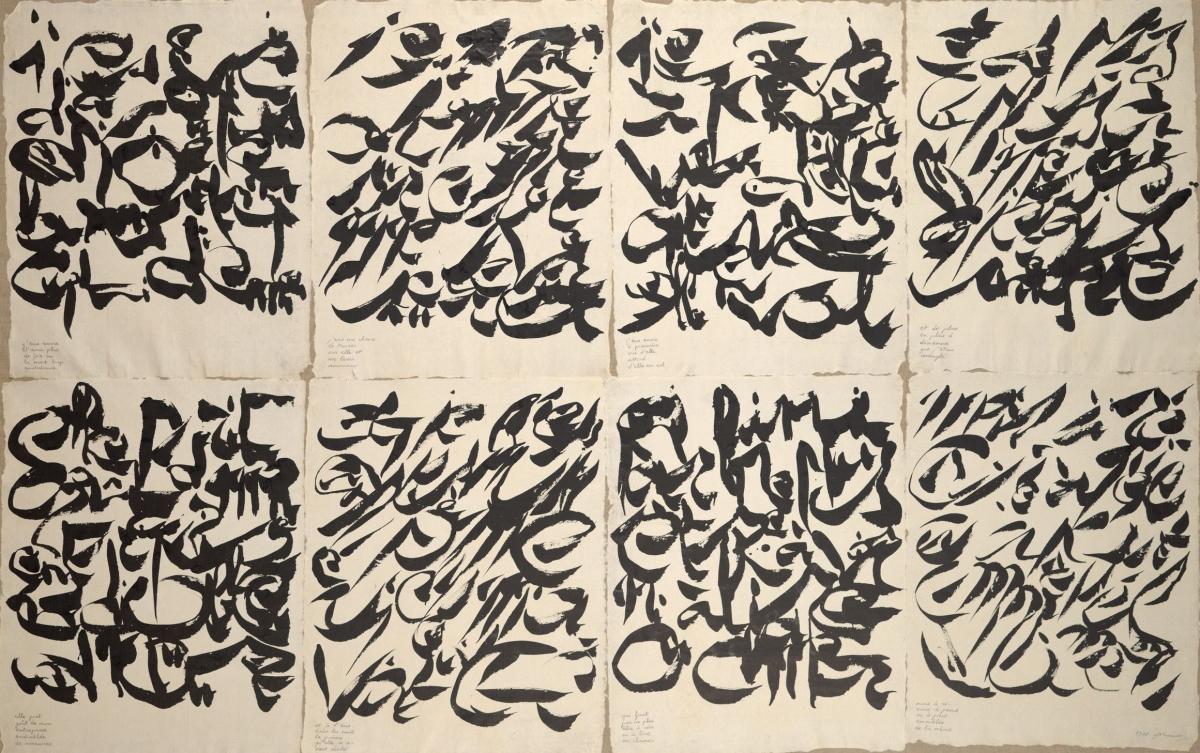
Christian Dotremont, a poet, writer and visual artist, was one of the principal founders of the Cobra Group (named after Copenhagen, Brussels and Amsterdam, the cities from which most of the artists hailed), which championed collective experimentation. In the aftermath of the Second World War, this group displayed a preference for naïve and folk art, Oriental and Chinese calligraphy, non-European art, and children’s drawings. In 1948, together with the Danish artist Asger Jorn, Dotremont created the first ‘word-painting’: the painter and the poet occupy the canvas simultaneously or alternately. A trip to Lapland and its vast snowy expanses would prove decisive in the subsequent development of his artistic career. This snow becomes the blank page and the black ink is the mark traced upon it. In 1962, the artist created the logogram, a fusion of word and drawing that causes language to vanish. The logograms (which he wished to call ‘anti-calligraphy’ to emphasise their illegibility) are sometimes accompanied by poems, as in this work comprising eight sheets of Japanese paper on which the logogram is juxtaposed with a short love poem. His exploration of writing led him, alongside his work as a writer, to the graphic poem that is the logogram.
This translation has been automatically generated by DeepL.