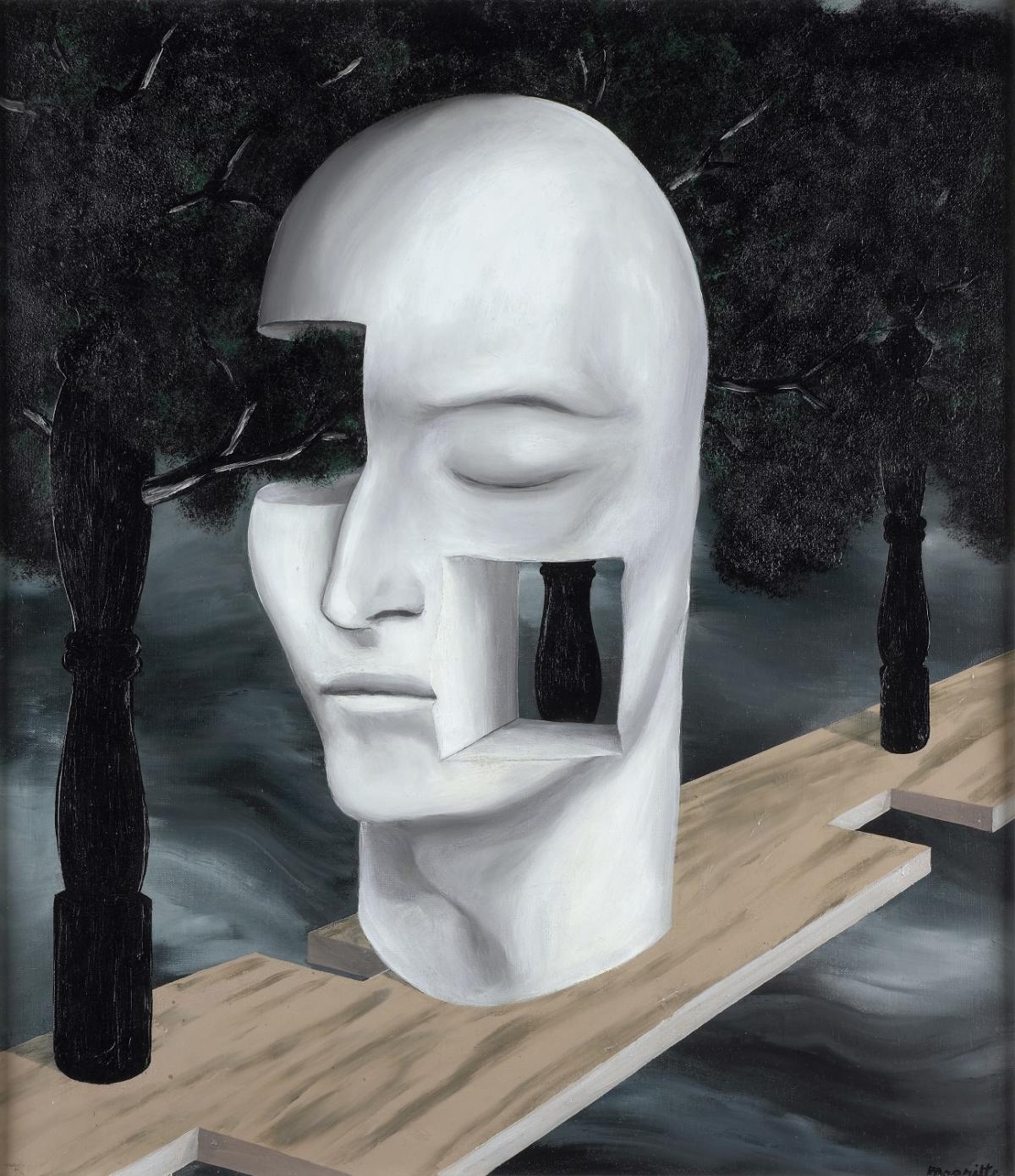
On a plank of light-coloured wood—a fragile footbridge spanning the void—lies a death mask. It has been cut in two places. It is Napoleon’s mask, and tree branches with trunks like cup-and-ball toys pierce through it. Lifeless, passive and silent, it brings to mind the white masks depicted in the work of Giorgio de Chirico. An Italian artist whom Magritte discovered around 1925 and who had a profound impact on him – just as he did on Paul Delvaux. In 1926, he thus painted his first Surrealist work, The Lost Jockey, followed by Face of Genius, which you see before you. On the canvas, Magritte projects a mental universe where ‘everything we see conceals something else’. In his work, certain elements recur like mysterious icons. This is the case with the cup-and-ball game, or the apple, the bell and the bell in other works. It was not until the late 1920s that the surrealist world, which would later bring him fame, truly took shape.In 1927, Magritte moved to Paris, where he rubbed shoulders with André Breton. The Surrealist movement was then in full swing in both France and Belgium. Born in the wake of the First World War, it rejected the sacrosanct rationality that had led to the great carnage of 1914–18. It was founded on the free projection of the unconscious, as revealed by Freud. To express his world, Magritte chose to continue painting in a realistic style, depicting elements which, taken together, form a strange and poetic universe. A provocateur, he believed in the subversive power of images. ‘I is another,’ declared the poet Rimbaud at the end of the 19th century. It is this ‘other’ that forms the basis of Magritte’s work, even though the painter would reject psychoanalytic interpretations of his works throughout his life.
This translation has been automatically generated by DeepL.