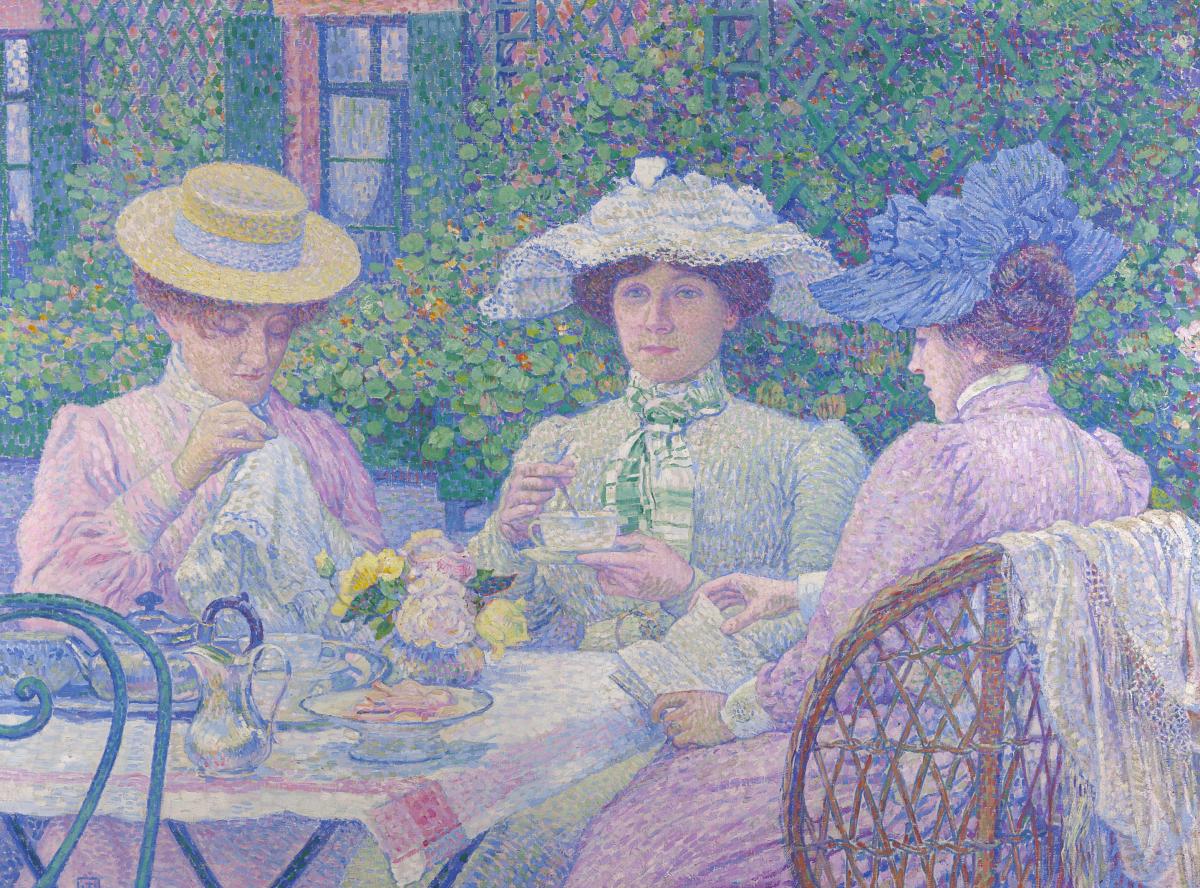
Life flows peacefully in this painting by Théo Van Rysselberghe. Seated around a garden table, three women are relaxing: one is embroidering, another is reading, whilst the third is daydreaming – or listening to her neighbour – with a cup of tea in her hand. The artist often depicted rest and leisure in the open air, from seaside strolls to games of tennis. Inspired by the bourgeois milieu to which he belonged, such scenes reflect his desire to paint his loved ones, and the light – here, that of a summer’s day. Van Rysselberghe began this oil on canvas in 1900. Exhibited at the Brussels Salon de la Libre Esthétique in 1901 under the title Summer Afternoon, he subsequently reworked it as he still found it ‘very imperfect’, as he wrote in a letter. His talent as a portraitist is evident in the three figures of women, elegantly dressed and coiffed. In the centre, one can recognise the singer Laure Flé, and on the right, Maria Van Rysselberghe, his wife. Both appear again in other paintings; indeed, the Kröller-Müller Museum in Otterlo holds a very similar composition featuring Maria’s silhouette as a reader. As for the figure on the left, no definitive identification has been established, with a connection to the poetess Marie Closset having been ruled out. Tea in the Garden bears witness to the highly personal Neo-Impressionism developed by Van Rysselberghe. Fifteen years had passed since his discovery of Pointillism in Paris in 1886, through the works of Georges Seurat and Paul Signac, who advocated the division of tones through a dotted brushstroke. Whilst Van Rysselberghe shared their quest for clarity and brilliance, by the early 20th century he was gradually moving away from the systematic nature of the technique. His brushstrokes range from small dots to expressive commas, via vibrant impasto – the texture of the white hat worn by Laure Flé seems almost to crackle. The artist also liberated his palette from strictly complementary combinations, in order to explore, in the words of art critic Paul Colin, ‘tenderly hostile colours – conflicts of greens and blues, of pinks and purples’. Guided more by her instinct and her powers of observation than by theoretical principles, Van Rysselberghe succeeds in creating a harmonious atmosphere, bathed in light and fully embodied.
This translation has been automatically generated by DeepL.