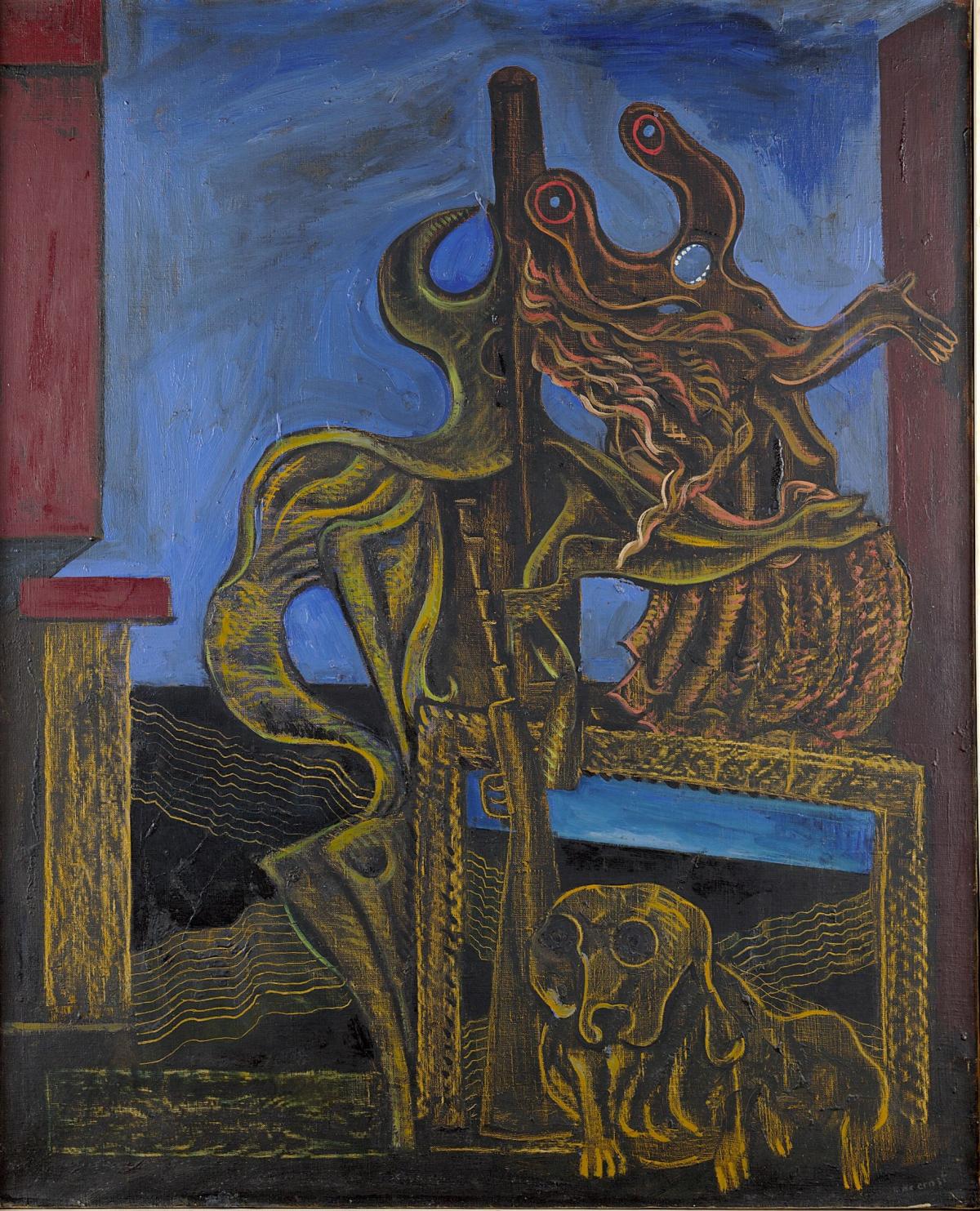
The horrors of the First World War, during which Max Ernst served in the German army, undoubtedly inspired this phantasmagorical vision of *The Hunter*. The Surrealists with whom he associated did the rest: a frame, behind the dog, creates a kind of optical illusion. An image within an image, it invites us to plunge into another reality. The sense of strangeness and unease, amplified by the contrast between the brown tones and the blue background, urges us to look beyond the motif and enter our own dreams. The Hunter was painted in 1926. Following the precepts of Surrealism, Ernst depicts the ceaseless flow of his unconscious, filled with dreams and nightmares, yet he chooses new forms, unlike Magritte who, at the same time, used realistic motifs. He thus employed techniques of his own devising, such as the undulating lines at the bottom of the painting, created by scraping. He also enjoyed placing a sheet of paper on the floor and sketching over the surface with a pencil, bringing imaginary motifs to light. These techniques undoubtedly transpose the process of writers’ automatic writing into painting. They allowed him to play with the notion of chance. Throughout his life, Ernst was committed to exploring the pictorial universe. His work, deeply personal and original, makes him one of the great artists of the 20th century. The Musée d’Ixelles holds two other works by Max Ernst, including *Birds, Foliage and Grapes*, bequeathed by the collector Max Janlet in 1977.
This translation has been automatically generated by DeepL.