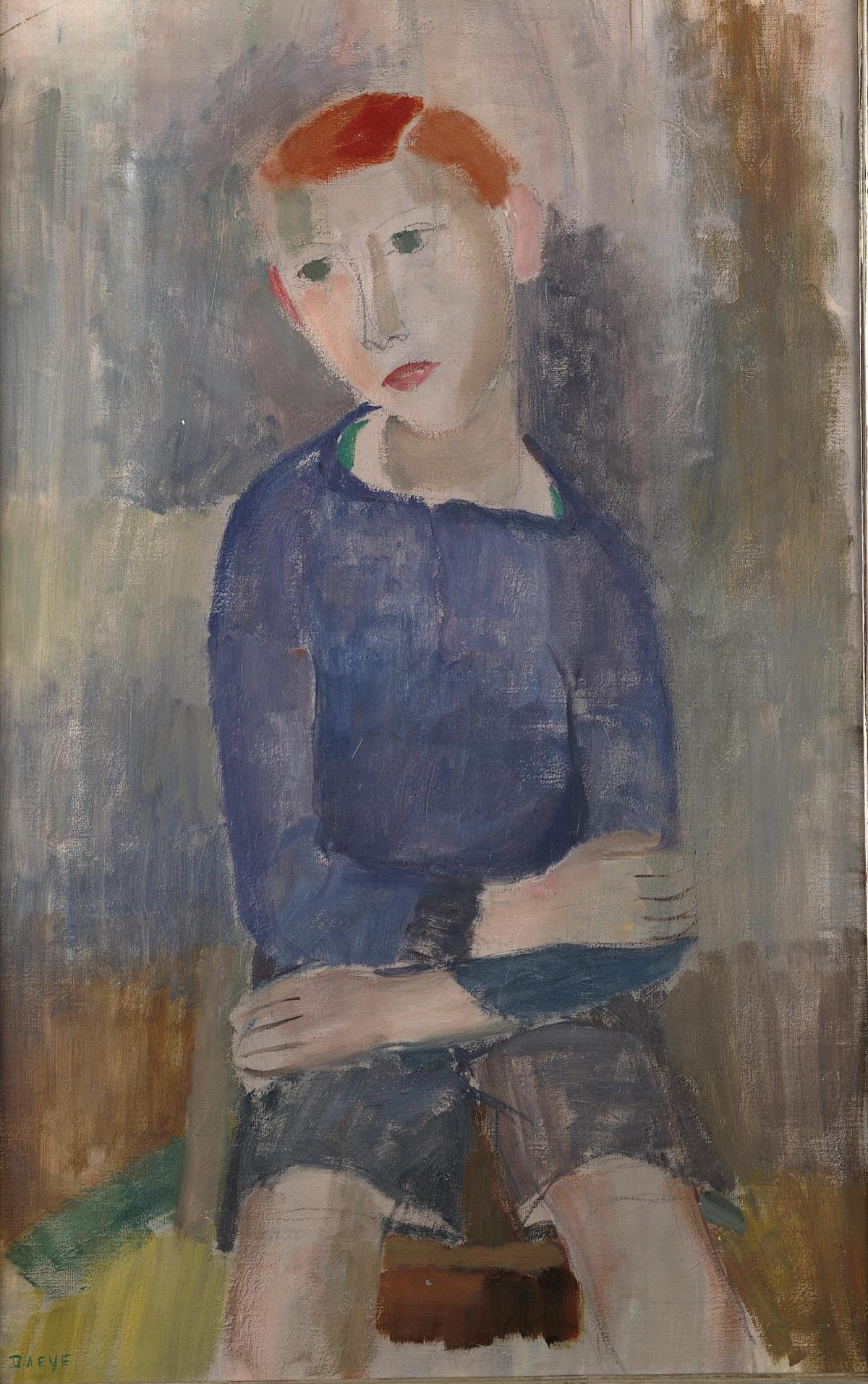
This portrait of a boy wearing a blue jumper, which gives the painting its title, was painted in 1929 by the Belgian artist Hippolyte Daeye. Having exhibited this *Chandail* at the famous Galerie du Centaure in 1930, Daeye was part of a vast artistic network, whilst developing his own distinctive style on the fringes. The catalogue of his retrospective at the Musée d’Ixelles describes the years 1929–1930 as ‘the most productive, and the most intense expression of a humble and simple truth’. The artist depicts babies, little girls and little boys individually. Sometimes his own children posed for him; here, it is the son of the housekeeper. Sitting on a chair, the red-haired boy has slumped shoulders, bent arms, bare knees and a distant gaze – a moving expression of a child’s innocence captured in his inner world, perhaps weary of ‘posing ’. The artist’s granddaughter, Bernadette De Visscher-D’Haeye, aptly described these ‘figures withdrawn into themselves (who) make no gesture, do not call out to us’. To convey this naturalness, this almost melancholic sensitivity, Daeye combines brushwork with a few supple, pronounced strokes, earning him comparisons with Modigliani, whose portraits of children Daeye admired, such as The Little Peasant in Blue (1918). For both painters, the so-called ‘primitive’ arts inspired a remarkable sense of synthesis, accompanied by a stylisation of the figure. In *The Blue Jumper*, the boy’s nose emerges from a long curved line, and two commas of green paint suffice to suggest his undershirt. The lightness of the brushwork contrasts with the impasto favoured by many of his contemporaries who, like him, sought great expressiveness, such as Permeke. Daeye further enhances the power of his portrait by opting for a background of ‘pure paint’, in shades close to those used for the model. Explored by Daeye since 1920, this type of abstract background helps to energise the composition, whilst drawing the eye to the figure.
This translation has been automatically generated by DeepL.