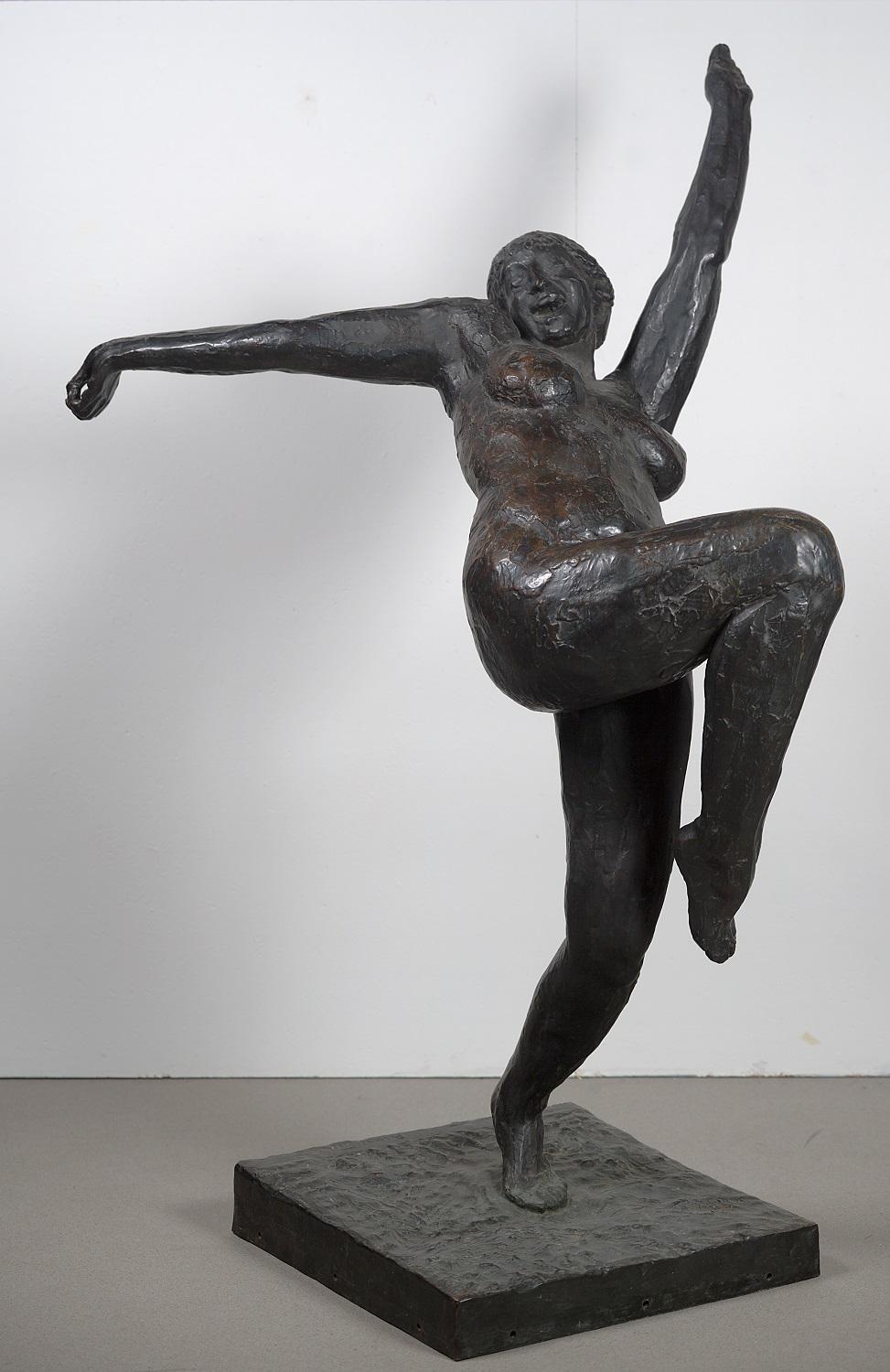
The Mad Virgin (also known as The Mad Dancer) is the best-known sculpture by the artist Rik Wouters. His wife and muse, Hélène, known as Nel Duerinckx, recounted the sculpture’s long genesis, in which she played a central role – it was she who modelled for her husband. This work represents the culmination of a quest spanning several years: how to translate movement into an immobile material? Wouters’ first attempt, Rêverie (1907), still resulted in a relatively hieratic figure, despite her swaying hips. However, at the end of that same year, 1907, a turning point occurred when the Wouters attended a performance by Isadora Duncan at the Théâtre de la Monnaie in Brussels. Duncan’s dance, with her arms outstretched and her thighs exposed in a series of liberated movements, reignited Rik’s quest for a lively and expressive figure. He produced a multitude of drawings, modelled studies (The Laughing Mask, 1909), and above all, sessions with Nel as his model, involving, in his own words, ‘the violent tension of every muscle’, to which ‘no professional model would ever have consented’... and this went on for three years. The result? A laughing bacchante, entirely nude, larger than life, who “explodes with vitality, without shame or restraint” (Francisca Vandepitte, art historian). Wouters modelled her by hand and with tools, leaving his work in the clay visible. The result is an irregular surface, rich in facets that catch the light. The technical feat is all the more remarkable given that the monumental figure stands on the sole of a single foot, thanks to a skilfully forged internal framework. Cast in bronze in early 1912, *La Vierge folle* was presented in the inaugural exhibition of the Galerie Georges Giroux in Brussels. Also included in a later exhibition by the Libre Esthétique, the famous Belgian writer Émile Verhaeren described it as a ‘masterpiece of the century’. Eight examples are currently recorded in public and private collections. Acquired in the 1960s, the cast in the Musée d’Ixelles is believed to be the second known edition.
This translation has been automatically generated by DeepL.