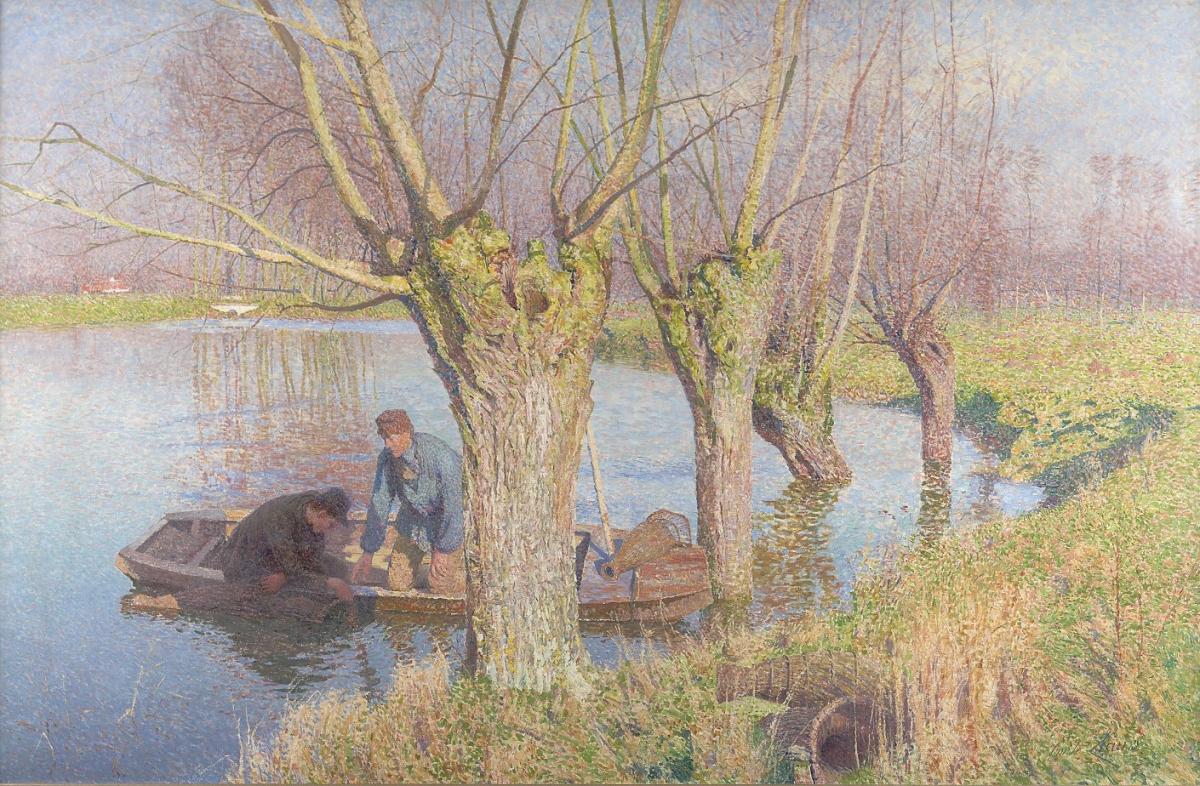
It was in February 1893 that Émile Claus painted this *Levée des nasses* (*Hauling in the Eel Traps*), in which he depicts eel fishermen on the banks of the River Lys, near Ghent. This painting is a fine example of works inspired by the Neo-Impressionist technique. Like many artists, Émile Claus discovered Seurat’s A Sunday on La Grande Jatte at the 1887 exhibition of Les Vingt, a work considered the manifesto of Pointillism. Yet, on closer inspection, Émile Claus takes numerous liberties with this rigorous technique. The optical principles of colour mixing are not adhered to. The density of the paint used to depict the willows gives them a luminous and vibrant glow. The background consists of small brushstrokes that dissolve the distance into the morning mist. The foreground, by contrast, reveals bold and expressive brushstrokes. Above all, the precise rendering of the two men reflects the ever-realistic concern of Belgian art. These differences are revealing. Whilst the French Impressionists dissolve forms under the effect of light and a fragmented brushstroke, Belgian Impressionism—known as Luminism, one of the forms of Belgian Impressionism—preserves its subjects. Émile Claus, fascinated by the ever-changing impact of light on nature, achieved great success with this painting, which was purchased by the municipality of Ixelles in 1893, the year it was completed.
This translation has been automatically generated by DeepL.