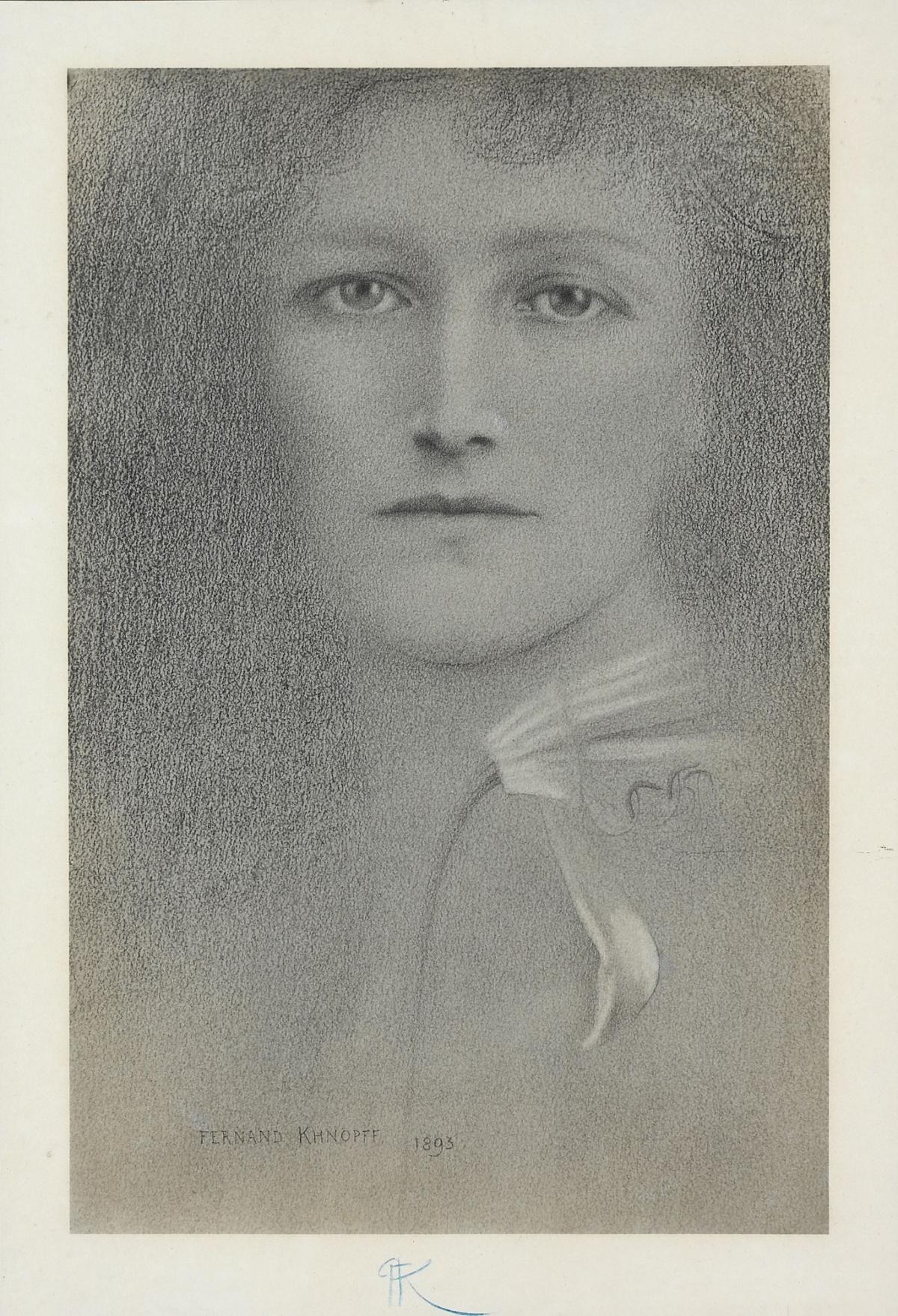
Fernand Khnopff’s sister, Marguerite, likely served as his model for *La Défiance*. Working from a photograph, he expressed his ideal of femininity by enhancing it with a drawing. This portrait, whose eyes—in whose depths one cannot tell whether to detect disdain or innocence—is accentuated by the whiteness of the lily, a symbol of purity. The oval of the face, barely defined, is emphasised only at the chin. A lock of hair caresses the forehead; the whole is bathed in a monochrome of greys that brings out the velvety quality of the pencil. The gaze, so significant in Khnopff’s work, immediately captivates the viewer, and one sees nothing else. One loses oneself in those pupils gazing into the distance. Fernand Khnopff’s art is part of the Symbolist movement that developed in the late 19th century. Reality is generally treated in a mimetic manner, yet it nevertheless contains a significant dimension of mystery and inner life. Beyond reality, beyond objects or beings, there exists a hidden side, a world of the soul where doubt, bitterness and unease reign. This attitude is just as symptomatic of a society in the midst of profound change as the optimism generated by various modern advances. This movement is reflected in particular by a return to religious themes conveying a moralising vision, pioneered in France by Gustave Doré, who illustrated the Bible and the Divine Comedy.
This translation has been automatically generated by DeepL.