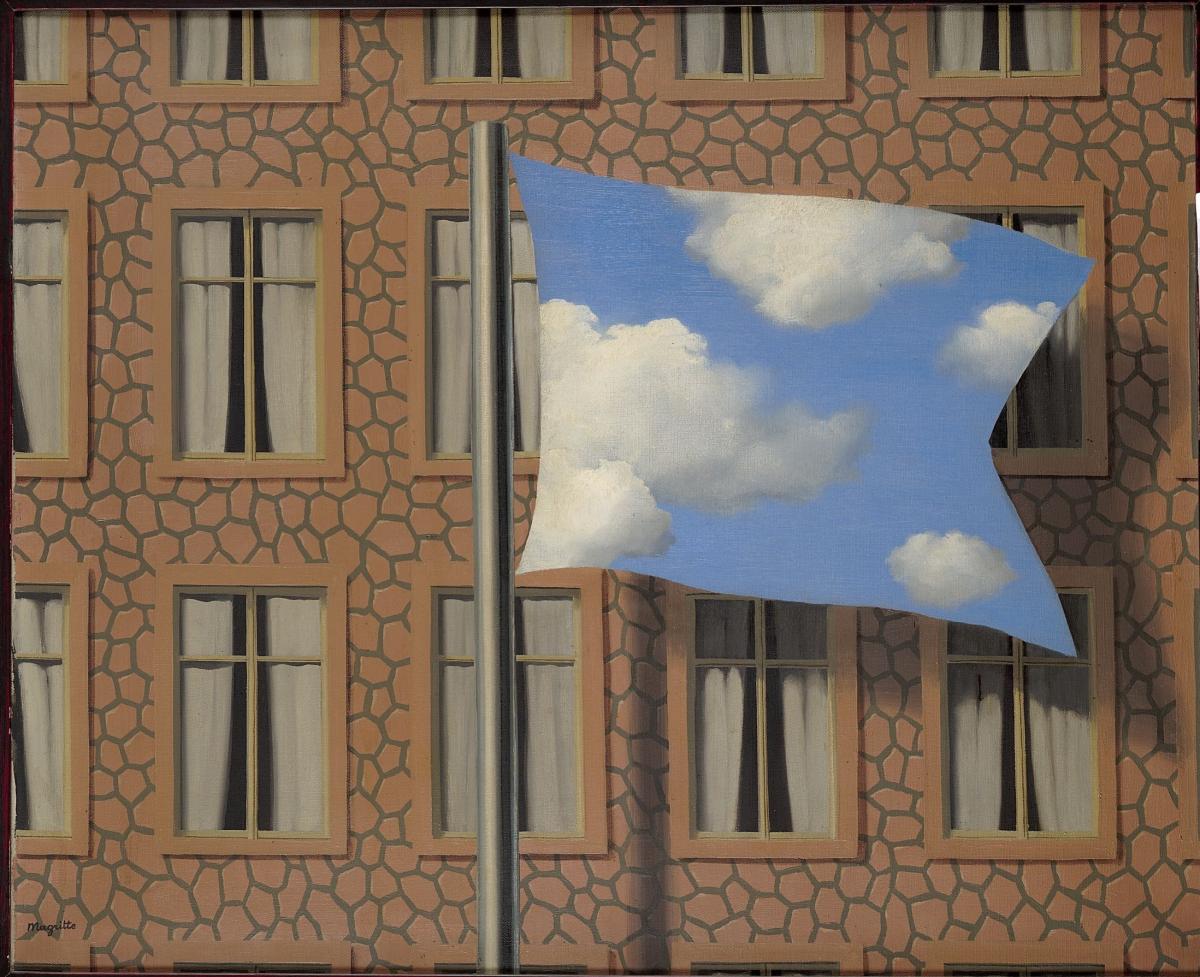
The sky has always fascinated artists, as Charles Baudelaire points out in his work *Le Spleen de Paris*. René Magritte is no exception to this rule. The blue sky, dotted with clouds, is indeed omnipresent in his work. But this ‘innocent’, almost childlike motif is subverted, displaced, or, as here, enclosed within a surprising space. In this painting, *L’Été* (Summer), created in 1932, the sky is placed within a flag. The flag is no longer the symbol of a society or a group of individuals; it has been transformed into a poetic surface, devoid of any political message. It has become a universal motif, a patch of blue sky in the heart of a cold, urban landscape. The title of the painting, however, is a provocation. Magritte wants the viewer to expect a graceful and colourful evocation of the season in question. Instead, he presents a sad, uniform façade, with lifeless windows, brightened only by the flag of clouds. Generally, the motifs Magritte invites us to examine are those of everyday life. These recur frequently in his work. One cannot, however, speak of fetishism, for in the artist’s work the object refers to no symbol other than itself. It is the incongruous combination of realistic motifs, unrelated to one another, that creates surreal situations plunging us into a mysterious world.
This translation has been automatically generated by DeepL.