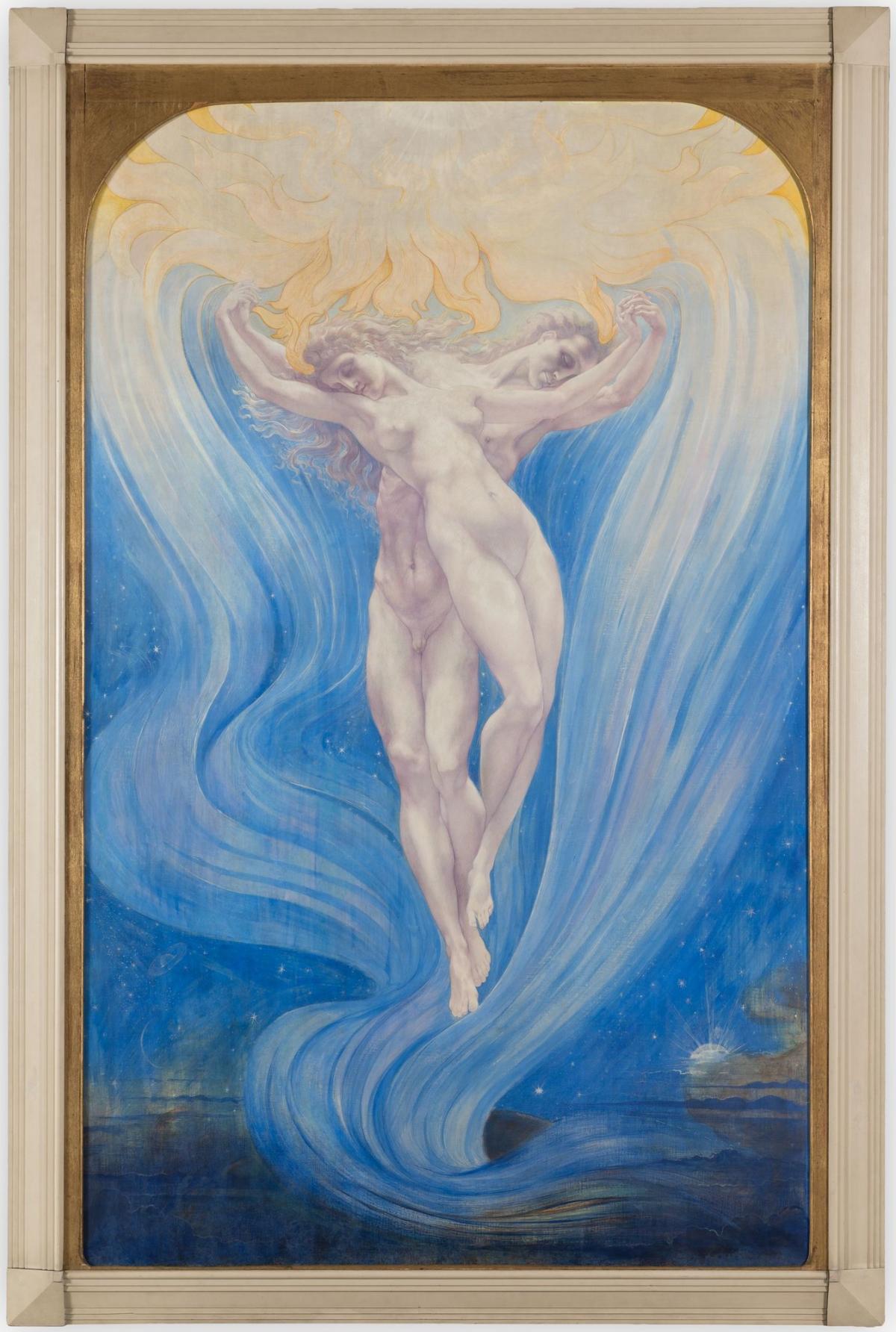
In a letter addressed to the curator of the Musée d’Ixelles in 1952, the artist Jean Delville described this monumental work as “one of his most characteristic”. Painted in 1900, “L’Amour des Âmes” immediately served as a showcase for his art, being exhibited that same year at the Salon de la Libre Esthétique in Brussels, as well as at the World’s Fair in Paris. Delville draws our gaze upwards to two figures intertwined right down to their fingertips, their eyelids closed, lost in their own world. Carried by undulating scrolls, the couple seem to rise towards a source of celestial light, edged with sparks. The complementary shades of yellow and blue bring out the two ethereal figures, with their finely modelled, statuary-coloured flesh. At the level of their feet, Delville includes fragments of the firmament, a planet, a sun, sparkling stars... This iconography forms part of the development of an art style described as idealist, close to Symbolism. According to Delville, the artist must be an “elevator of the spirit”, seeking total spiritual and aesthetic communion – in the image of this couple, embodying “the supreme harmony between two beings who escape together towards infinity” (F.-C. Legrand). Another idealist characteristic is that the artist appears to have drawn upon a wide variety of sources, which he combines freely. “L’Amour des Âmes” has above all been linked to the myth of the androgyne, a hybrid body split by the gods into two halves, a man and a woman, who would thereafter seek to reunite to regain their original unity. Described in antiquity by Plato, the androgyne was revisited by fin-de-siècle idealists, seekers of the absolute. One of the preparatory sketches for the work reveals a note by Delville, “see Kunrath’s Pentacle”, this time a reference to a 16th-century German esoteric alchemist. Delville also draws on a revisited past in terms of the technique employed. He regularly claimed that he painted his picture using egg tempera, a very ancient process, although a material analysis has revealed that he also used gouache and oil. Formally, through its celebration of the curved line, “L’Amour des Âmes” evokes both the Italian Renaissance – having won the Prix de Rome in 1895, Delville had recently spent time in Italy, immersed in Botticelli’s serpentine figures and Mannerist elongations – and Art Nouveau, which was contemporary to him. For Delville, the line is the foundation of everything: “Art began with Drawing, with the Line, and the Line is the very essence of Plastic Arts… The Line, in the things of Nature, is the signature of God.” (La Mission de l’Art, 1900). Here, it enables him to give form to his dream of transcending all duality, through a surge of transcendent love.
This translation has been automatically generated by DeepL.