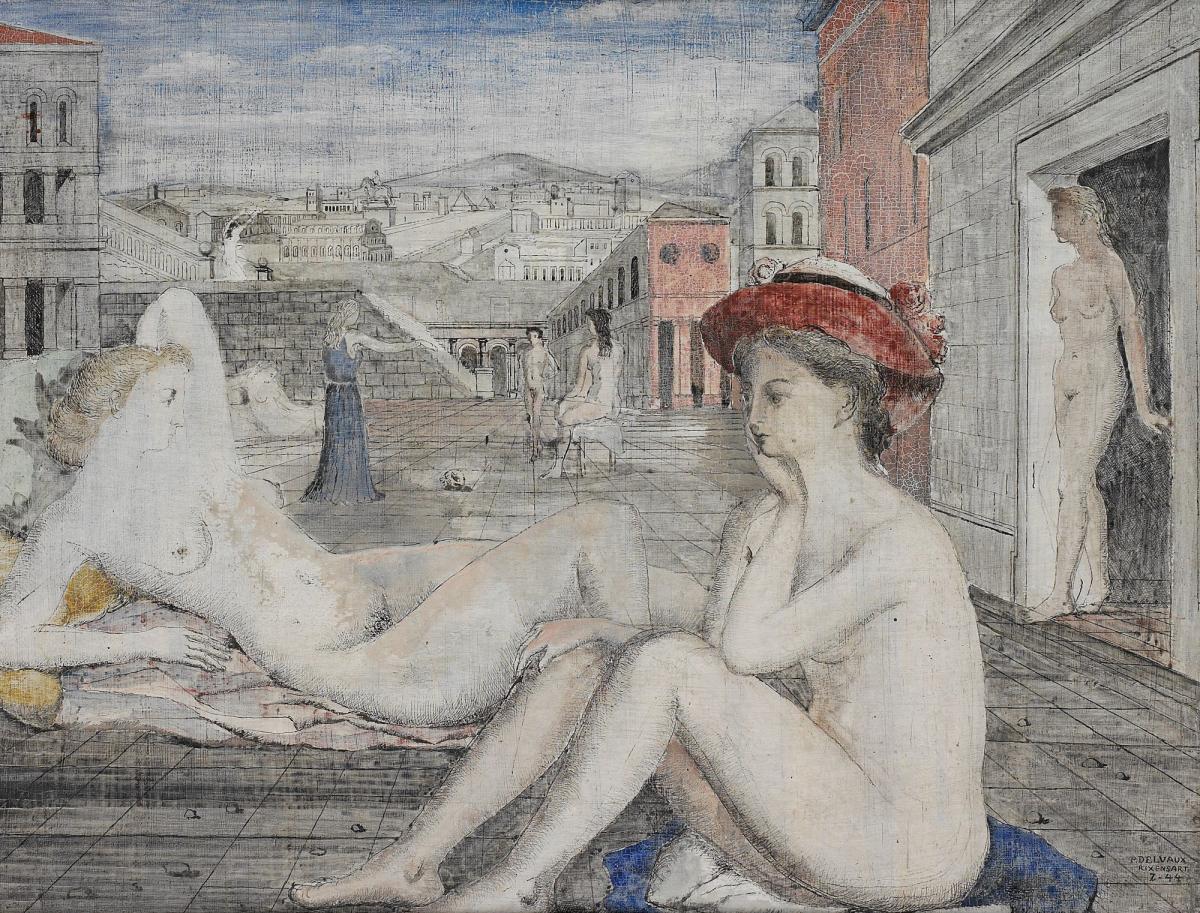
In *Naked Women or Ancient Landscape*, Paul Delvaux depicts, as is often the case in his works, an enigmatic scene in which numerous women command the viewer’s attention. The painting offers a surrealist vision in which disparate elements create a poetic contrast. The space blends interior and exterior. The vanishing-point perspective evokes Renaissance art and Neoclassicism. The temples and façades are meticulously rendered, with a distinctly architectural style. We find ourselves immersed in a setting from Greco-Roman antiquity, a period for which the artist had developed a passion from a very young age. In the foreground, a woman lies reclined, her arm bent backwards, a reference to the theme of the Sleeping Venus. Paul Delvaux was inspired by this subject whilst looking at a wax Venus on display in the Spitzner Museum’s fairground tent at the Foire du Midi in Brussels. Created in 1944, the work has a distinctive feature: the artist worked in Indian ink on a wood fibreboard panel covered with zinc white. He then enhanced the drawing with watercolour. He often made corrections to his drawings. Indeed, in the doorframe on the right, one can see an unremoved correction to the leg of the nude woman.
This translation has been automatically generated by DeepL.