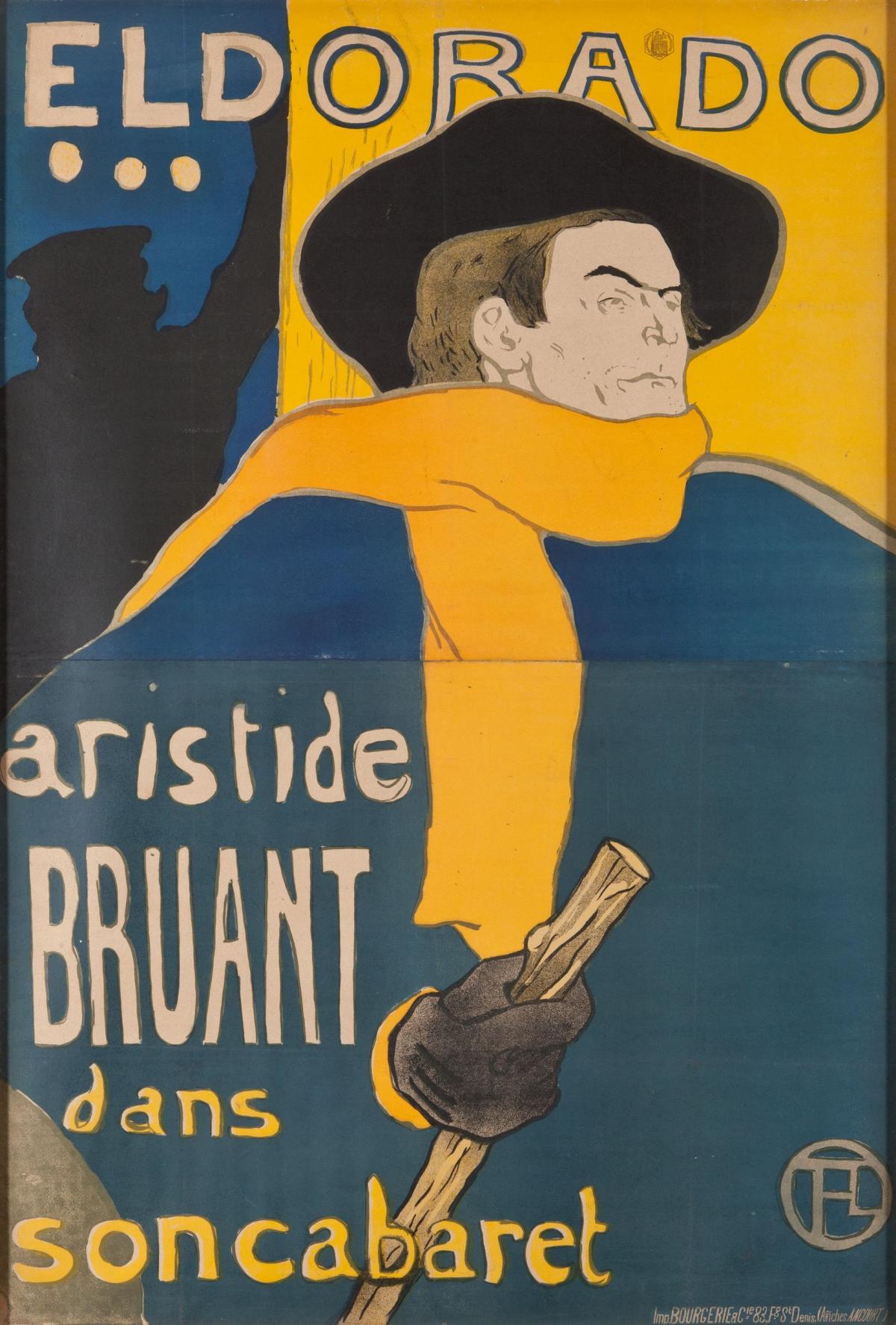
“Tall, with a broad, rounded chest, he has the profile of Bonaparte, but his eyes are mischievous and his lips ironic.” This imposing figure, described by the French Symbolist writer Rodolphe Darzens, is none other than Aristide Bruant, the champion of the underprivileged. He was a singer-songwriter and writer, and one of the greatest poets of slang. In 1892, he had just been admitted to the Société des Gens de Lettres. He met Henri de Toulouse-Lautrec when the latter settled in Montmartre, and was among the first to take an interest in his work. Toulouse-Lautrec depicts Bruant with a few characteristic features familiar to all: the scarf, the large black hat and the club he uses as a walking stick. The figure is emphasised by the absence of any background. Only the figure of the stagehand, placed in the shadows and rendered in black, in the top left corner, adds a sense of depth. This poster mirrors the one entitled Aristide Bruant, Ambassadeurs, named after a famous café on the Champs-Élysées. It was during his visit to this establishment that Bruant commissioned his first poster from Lautrec. At the time, the manager of the Ambassadeurs refused to pay for it when he saw it. He found its composition too daring, too crude and vulgar for his clientele. Bruant threatened not to perform on stage unless he accepted it and demanded that it be displayed on either side of the stage and plastered all over the city on the very evening of the performance.
This translation has been automatically generated by DeepL.