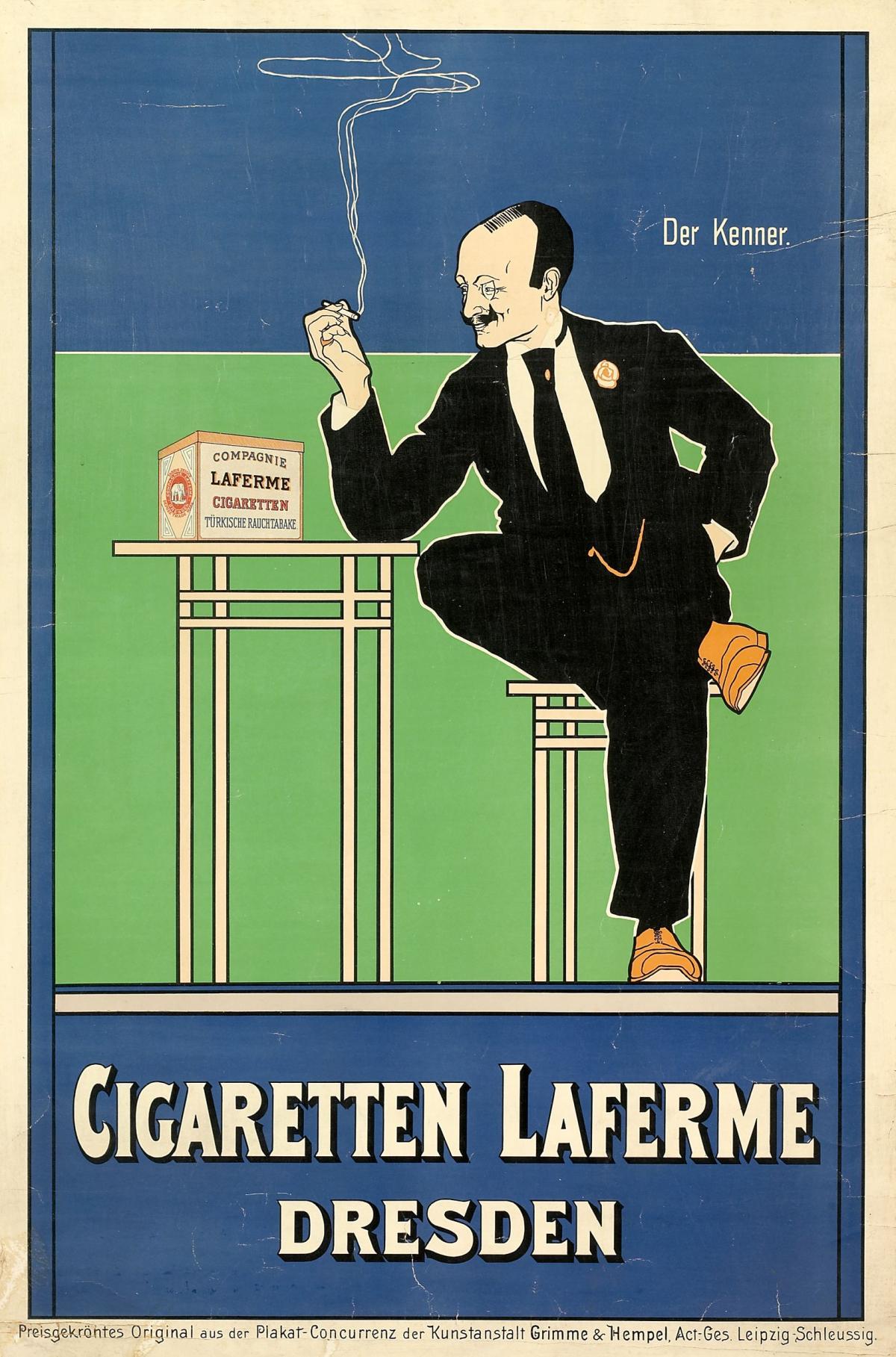
The ‘Cigaretten Laferme Dresden’ poster, created around 1910 by the artist Fritz Rehm, embodies the modern elegance and visual impact characteristic of early 20th-century German poster art. The poster’s composition is based on bold blocks of colour, clear geometric forms and a streamlined design with crisp outlines. This graphic style is typical of the Plakatstil, a poster style that emerged in Germany at the start of the 20th century as a reaction to the more ornate aesthetics of Art Nouveau. The simple image depicts a man dressed in an elegant black suit, sitting casually at a table, a cigarette in his hand from which rises a stylised wisp of smoke. Beside him sits a box of Laferme cigarettes. The figure, with his self-assured gaze, is identified by the inscription ‘Der Kenner’ (‘The Connoisseur’), creating the image of an elegant brand, accessible to those who appreciate quality products.The contrast between the geometric background and the expressive figure suggests a tension between tradition and modernity, between personal refinement and industrial production. Laferme, which was one of the first companies to exploit the potential of the printed image for tobacco marketing, played an active role in shaping the visual identity of German industrial modernity, whilst helping to establish the cigarette as a symbol of social distinction. Founded in 1862 by Joseph Michael von Huppmann-Valbelle in Dresden (Germany), the Laferme Company was a subsidiary established by the Russian firm of the same name to avoid the heavy taxes on tobacco in Russia. As the city’s first cigarette factory, it made a significant contribution to its industrial development. Gradually, Dresden became a major centre for cigarette production, to the extent that by 1920, one in four cigarettes sold in Germany was manufactured there.MLF
This translation has been automatically generated by DeepL.