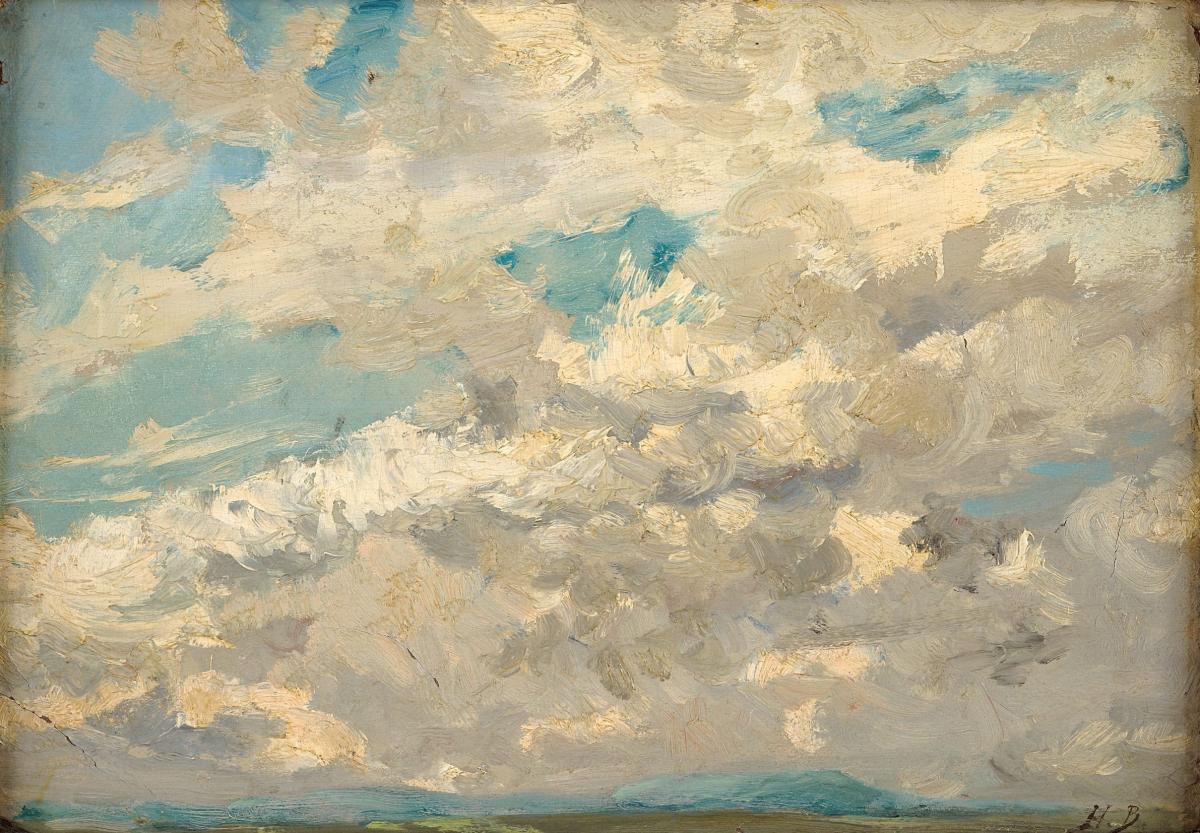
By capturing on a small wooden panel this highly sensory snapshot of the clouds passing by, Hippolyte Boulenger strips landscape painting of all its topographical and picturesque dimensions. The observation of the sky, atmospheric variations and the play of light becomes the starting point for an exalted pictorial exercise, asserting itself through impasto and visible brushstrokes, which convey a fully embraced personal expression. As L’Art moderne noted in 1881, ‘Everywhere one senses the hand, one senses the touch—active, skilful, energetic—applying the brushstroke, lifting the touch, catching the light or the accent in just the right places (…) Spring, the morning, the light, the slender branches, the orchards in bloom, the meadows of a dewy green, the delicate skies, brightened by a rainbow when he darkened them with a storm, the whiteness of a snowy winter—this is what his palette knew how to bring to life.” Active for a good ten years before his untimely death, Hippolyte Boulenger went down in the history of Belgian art as the ‘foremost precursor of the Impressionist landscape in Belgium’ (Serge Goyens de Heusch). He was also the leading figure of the Tervueren School, which he founded in 1866 to describe the artists – himself included – who settled in Tervueren to paint en plein air in the Sonian Forest. The term chosen was a nod to the French precursors of the ‘Barbizon School’, who set up their easels on the edge of the Forest of Fontainebleau.
This translation has been automatically generated by DeepL.