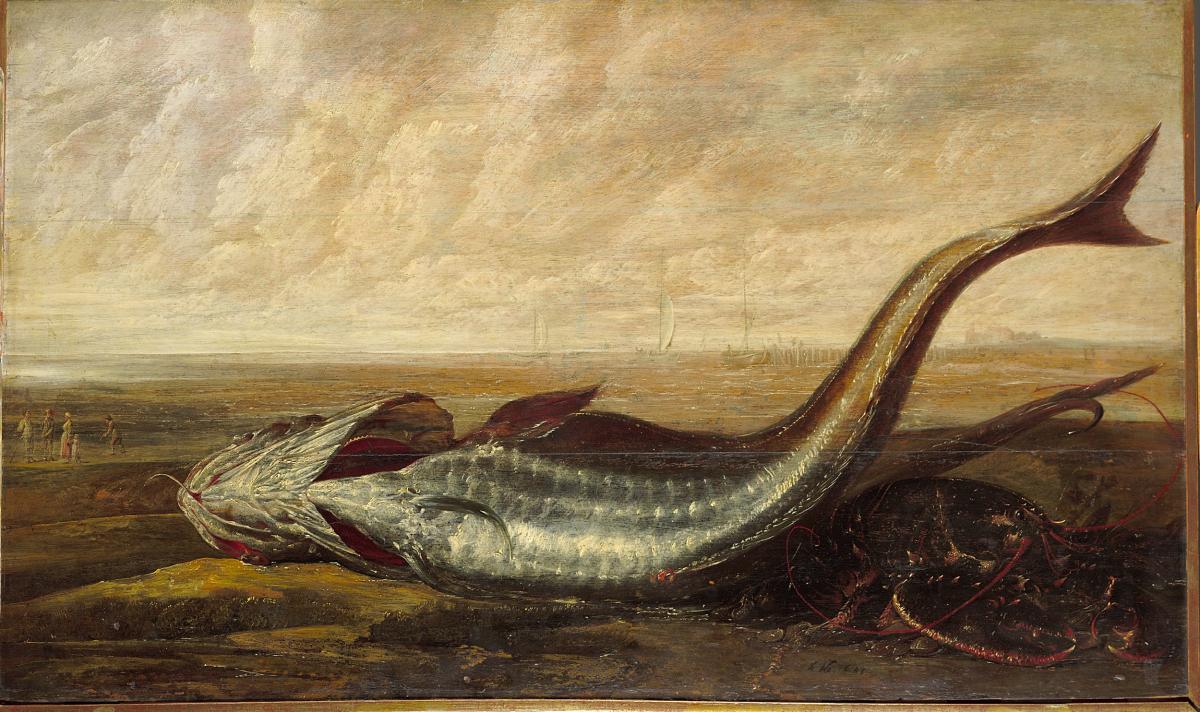
Although better known for his peasant scenes or more lavish still lifes, this close-up of a cod is a rarity in the oeuvre of François Rijckhals, a 17th-century painter of the Dutch school who worked in Middelburg (Zeeland). Apart from this one, only two other similar paintings by his hand have survived, all executed around 1642–43. This Cod on the Beach can be compared to other compositions of the period depicting freshly caught fish laid out on the shore, with a lively landscape in the background, sometimes painted by a second artist specialising in that genre. But Rijckhals distinguishes himself from painters such as Jan Van Kessel I or Willem Ormea through his choice of an original scale: the single fish, a cod, appears disproportionately large compared to the figures on the beach, the distant silhouette of buildings and the maritime activity in the background. Note here the reversal of the academic hierarchy of pictorial genres, which traditionally places history painting and the human figure above landscape and still life. Although this subject was not his speciality, Rijckhals demonstrates great mastery in detailing the anatomical features of the cod – its gills, scales, and barbels on its chin… The inclusion, in the bottom right-hand corner, of a lobster—a crustacean that always appears alongside the fish in Rijckhals’s work—allows him to add red to his palette, which is otherwise dominated by brown, ochre and grey tones. Between the two animals lies a gaff, with its hook used to haul large fish out of the water. These various elements can be interpreted as Christian symbols (the fish for Christ, the lobster for the Resurrection, the gaff for the Holy Lance), but such a still life should primarily be regarded for its high decorative value, celebrating fish and fishing, emblematic of the diet and economy of the United Provinces.
This translation has been automatically generated by DeepL.