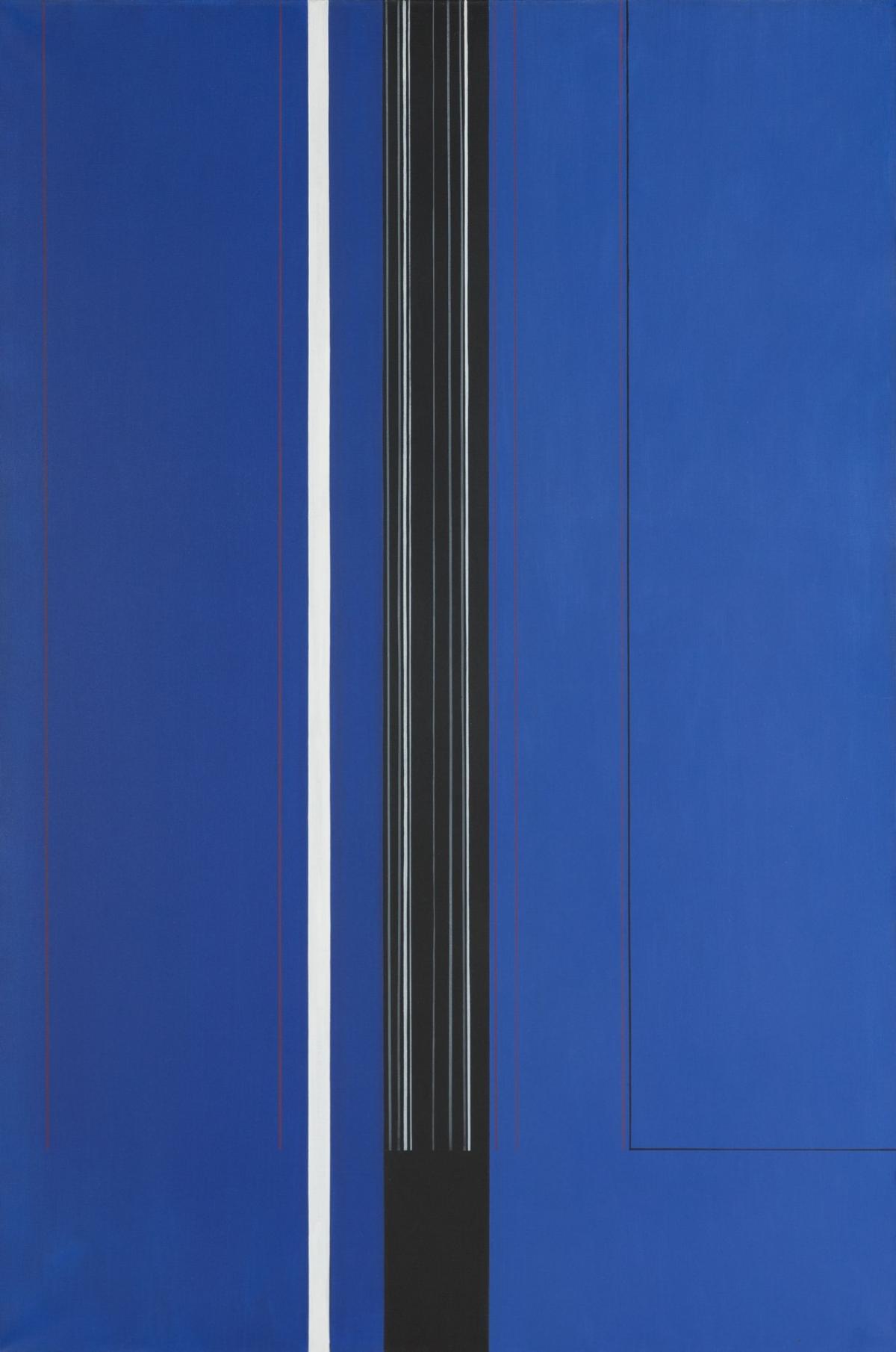
As its name suggests, Bruges (1968) draws its inspiration from an urban landscape, much like another work from the same year, Venici. The motif is stylised into an extremely vertical outline. The work marks a turning point in the painter’s career. It was indeed following a stay in New York in 1965–66 that the artist began to favour abstract verticalism, a style he would never abandon. Though seemingly simple, the painting is the result of extensive reflection and subtle construction. The painter alternates broad bands with fine vertical lines against a monochrome blue background, whilst rectangular forms still remain. Whilst blue predominates, other colours punctuate the pictorial space: white, black and red enliven the composition and evoke other spaces. Some lines run vertically across the entire canvas, whilst others stop at three-quarters of the way and echo the black rectangle. The gaps between the bands and lines vary each time, guiding the eye as it moves across the painting. This vertical rhythm almost evokes a mystical cadence. The colours indicate shifts in emotion. The light, luminous tones reflect a peaceful state of mind.
This translation has been automatically generated by DeepL.