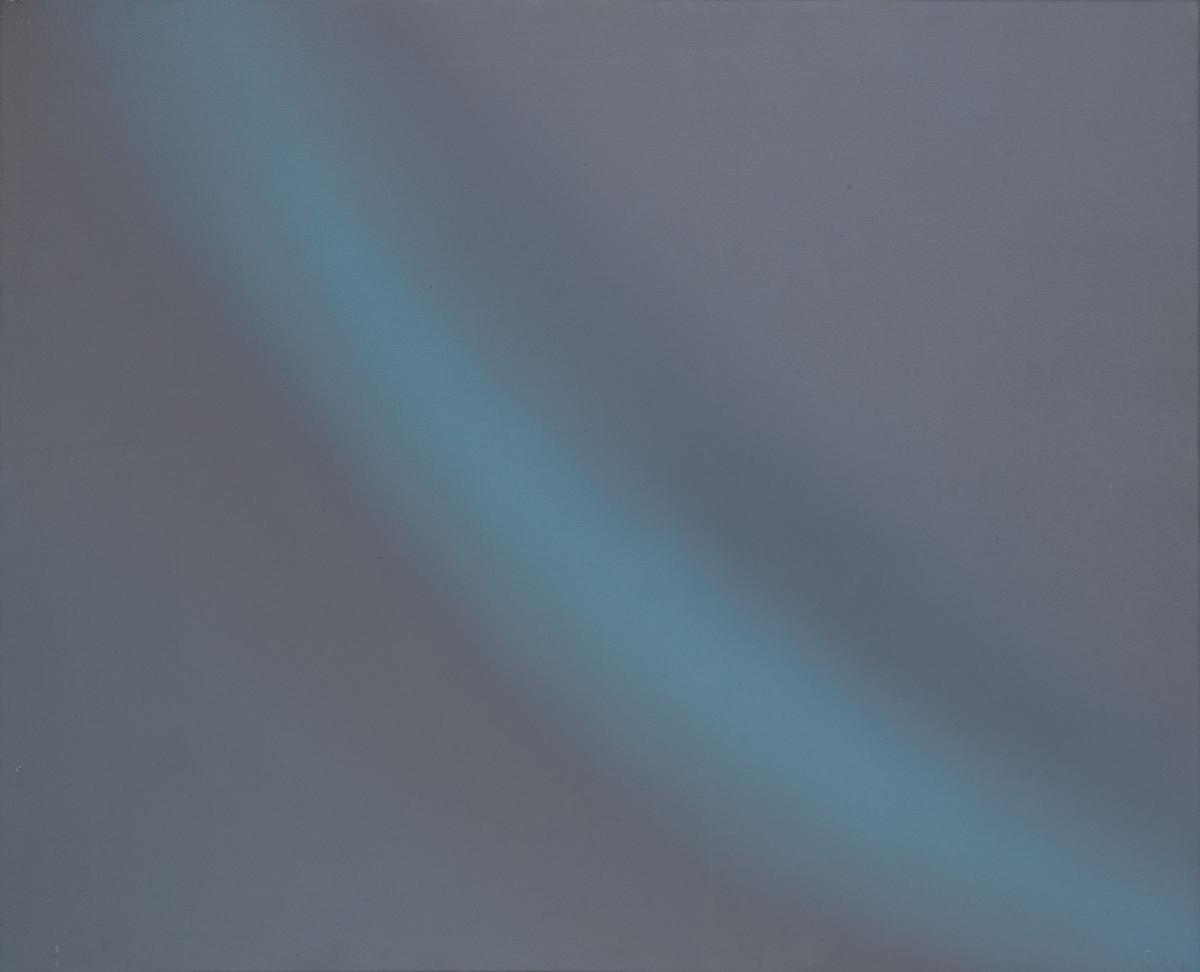
In *Arc de lumière*, Jef Verheyen reveals the outcome of his lifelong quest to capture light. This work brings to light various interplay of the same shades of a single colour, in order to bring them into a certain state of vibration. He calls this ‘essentialism’, as he wrote in 1959 in the journal *Het Kahier*. Art must move, vibrate and trigger a new optical dynamic. Acting as a link between the Zero group and Belgian artists, Verheyen, alongside artists such as Walter Leblanc and Paul Van Hoeydonck, developed an affinity with minimalism. Zero art is the art of monochrome paintings, but also of light and movement. From the 1960s onwards, the group’s members sought to express the pure possibility of a new beginning, far removed from any reference to the past. In this sense, they turned their backs on the pessimism of times of crisis and championed innovation wholeheartedly. But unlike the Zero group, which used new materials, Verheyen remained faithful to traditional painting techniques. He began exploring the effects of colour iridescence, that is, the refraction of light on the surface of the colour. He experimented with the multiple reflections of colour on a transparent surface. This is what we see in Arc de lumière, which was also created in 1962. Here we see the combination of an immaterial effect with spatial expansion.
This translation has been automatically generated by DeepL.