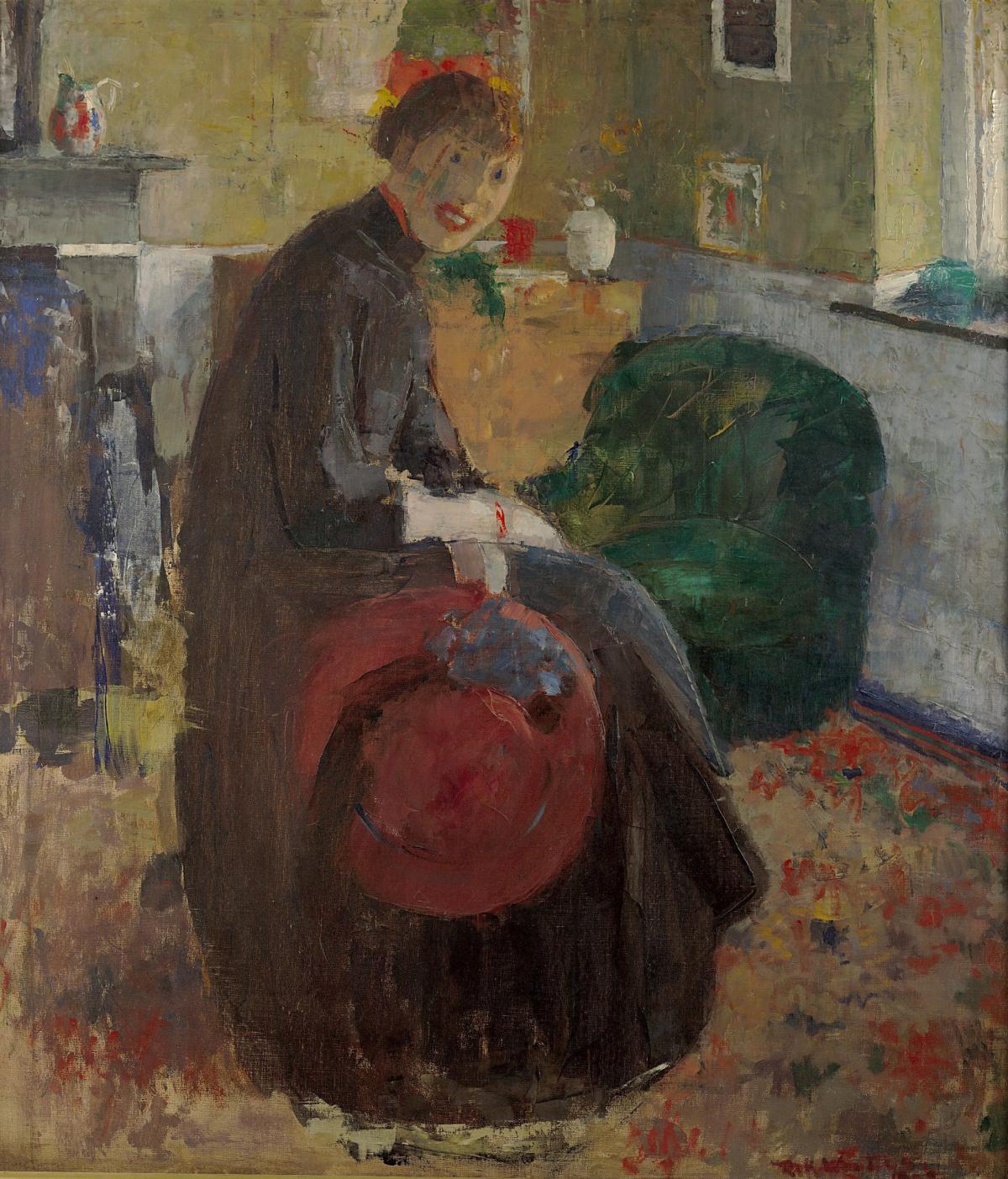
The brief but dazzling career of Rik Wouters, who died in 1916 at the age of 33, makes him a leading figure in Belgian modern art. He is regarded as the leading figure of Brabant Fauvism, a movement advocating vital expression through flamboyant colour and a free style of painting. Depicting his wife and muse Nel in their home in Boitsfort, this large yet intimate canvas dates from 1908, before the term ‘Fauvism’ had even been coined. Originally trained as a sculptor, Wouters began experimenting with a technique that strongly appealed to him: painting. He tried out various tools, notably the palette knife, which allowed him to spread the colours in thin layers that caught the light, not unlike the Impressionism of James Ensor. Like Ensor, Wouters was interested in the rendering of light, but here it remains discreet and subdued – the light enters the interior through a window off-screen to the right; there is as yet no sign of the bold sunbathing scenes that would later illuminate Nel. Nevertheless, Nel in the Red Hat is already a powerful painting, notably due to its balanced composition, with the central figure in the foreground dominating the space. Wouters demonstrates a remarkable sense of synthesis: Nel’s eyes are reduced to two blue dots, her smile to a white line illuminating her red mouth – and her face radiates joy with striking expressiveness. The artist also reveals his talent as a colourist when he brings the glass of the armchair closer to the complementary red of the hat, opting for a white glove streaked with red as a transition. The spontaneity of his painting is evident in the almost abstract carpet on the floor and in his fluctuating brushwork: from impasto to mark the window frame, to the absence of paint, revealing the raw canvas. This temptation towards lightness would soon lead him to abandon the palette knife in order to devote himself to an airy, sun-drenched style of painting, diluted with turpentine.
This translation has been automatically generated by DeepL.