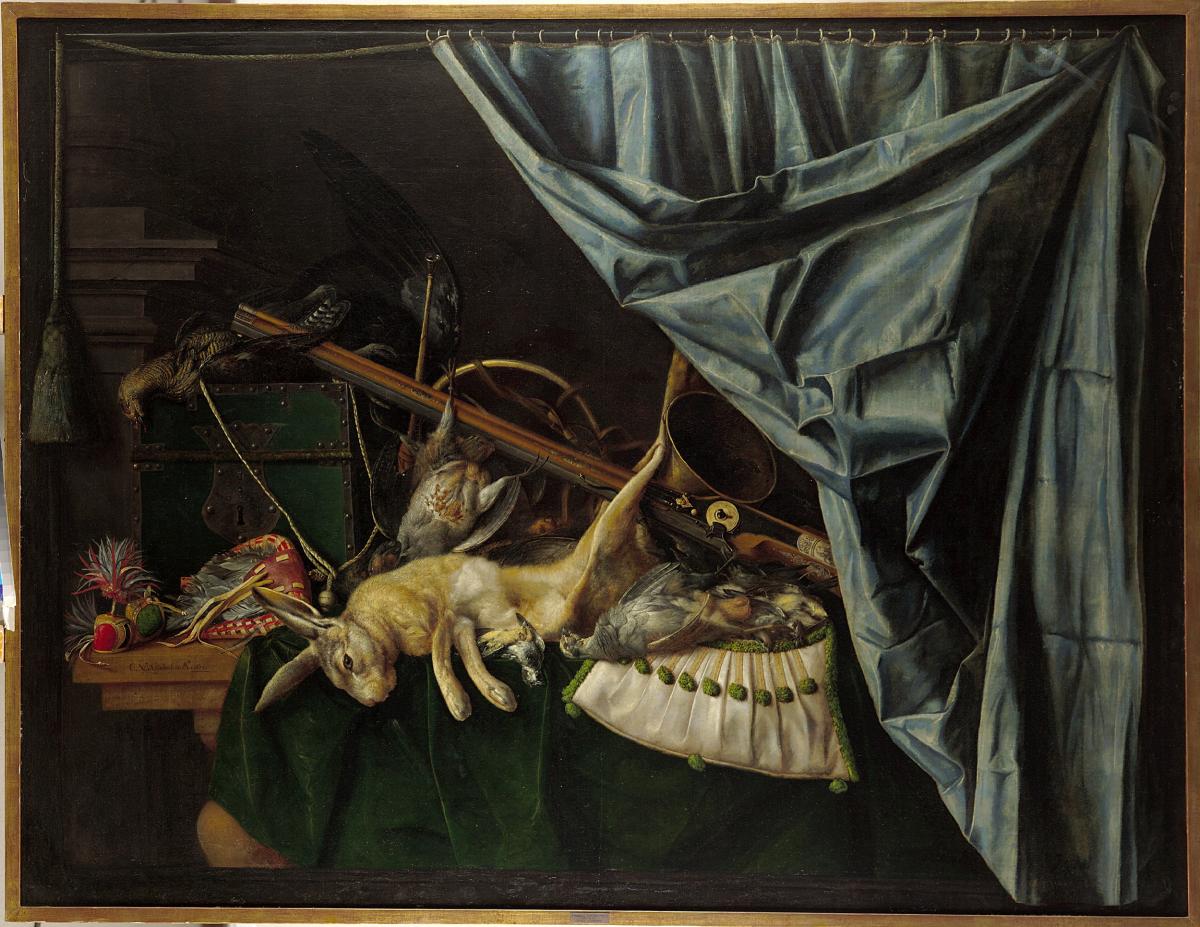
The mystery surrounding the 17th-century Flemish painter Cornelis Norbertus Gijsbrechts remains unsolved. A court painter to the Danish monarchs between 1668 and 1672, he is regarded as one of the greatest Baroque masters of trompe-l’œil. This painting, produced in Copenhagen, was likely part of a major commission for some fifteen trompe-l’œil works placed with the artist by King Christian V, a keen hunter. A large satin drape, gathered halfway up, reveals a scene depicting the return from a falconry hunt. Hares, pheasants and other birds, along with a rifle, a game bag (a bag containing the shot game) and a horn, are piled upon a table draped with a deep green tablecloth. One can sense the influence of Flemish animal painters such as Jan Fyt (Interior of a Cellar). Gijsbrechts masterfully renders the various textures of the scene (feathers, fur, velvet, copper). Game still-life was considered a ‘sub-genre’ of painting in the 17th century, yet it remained the most prized by the Flemish and Dutch elite, for whom hunting remained a privilege. Indeed, this type of still life sought to reflect the opulence, wealth and social standing of the game’s owner and was displayed in the dining rooms of residences and hunting lodges. The subtle touches of red on the falcon’s hood and the game bag intentionally contrast with the overall colour scheme to emphasise the prestige of the activity. A master of illusion, Gijsbrechts directly engages the viewer, inviting them to reveal the scene by pulling the cord and lifting the curtain. This deceptive theatrical illusion, fully in keeping with the Baroque vein of Flemish still life, is in fact twofold, as the work was probably itself protected by real curtains. This deception naturally evokes the ancient myth of Zeuxis and Parrhasios, two Greek painters who competed in a contest to determine which of them was the better. Zeuxis managed to deceive the birds with painted bunches of grapes, but Parrhasios, for his part, succeeded in deceiving Zeuxis himself with a painted curtain which the latter asked him to lift in order to reveal his work.
This translation has been automatically generated by DeepL.