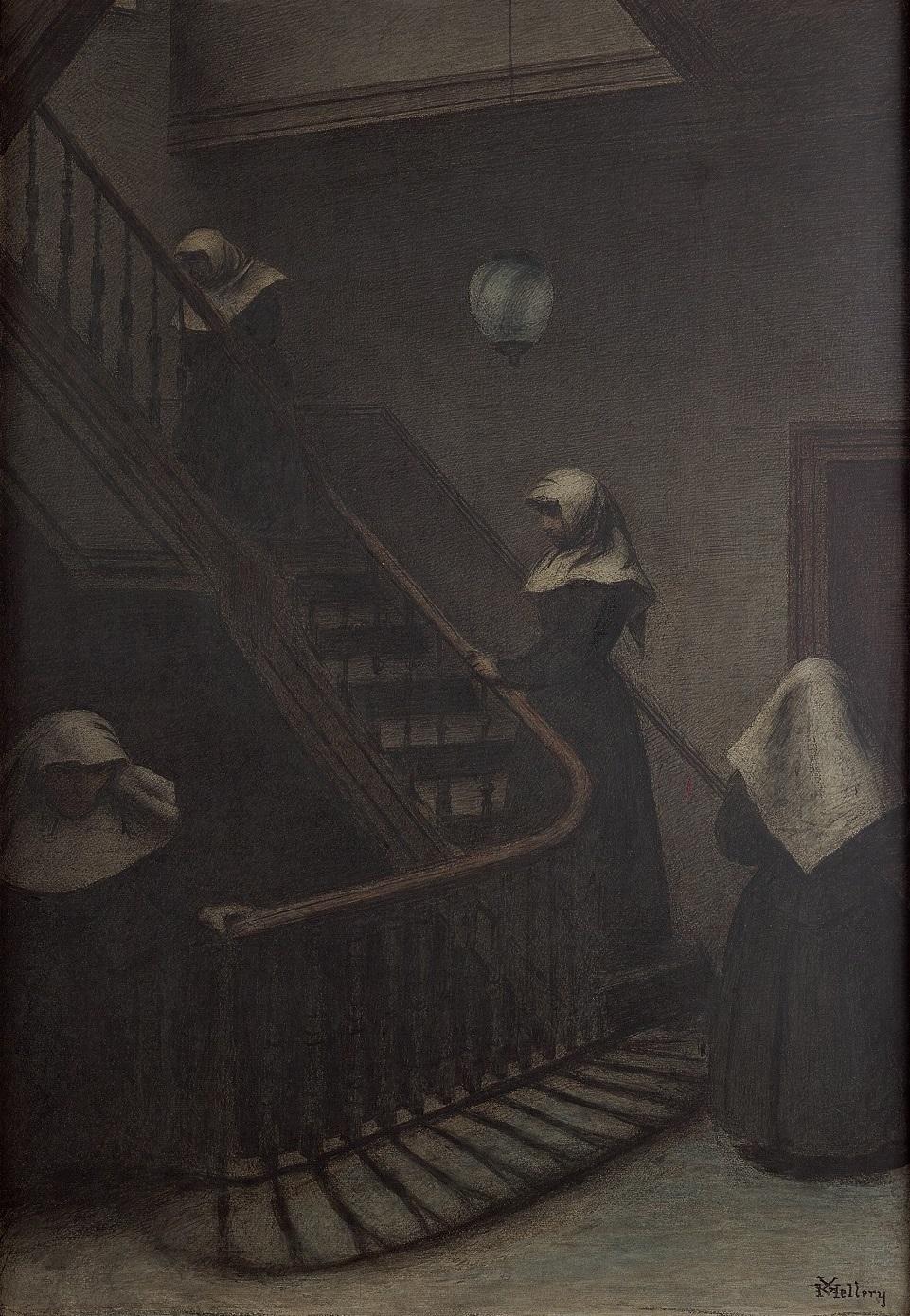
Following an academic career crowned by the award of the Prix de Rome, Brussels-born Xavier Mellery has developed a highly personal body of work, which can be divided into two categories: allegorical works heralding idealism, and symbolist works of a more intimate nature – such as this large drawing. After Evening Prayer combines his favourite subjects: seemingly innocuous spaces, often transitional – here, the stairwell – of his home in Laeken, which ‘revealed the soul of things’ to him, and the Beguines, nuns who once lived in communities. The first time Mellery depicted Beguines was in his illustrations for the book *La Belgique* by Camille Lemonnier, a writer with whom he travelled the country in the 1880s. Lemonnier would later remind him, ‘Do you remember, you, the lover of pale nuns and suffering creatures, do you remember, my dear Mellery, our visit to the beguinage in Ghent’… In this drawing, probably produced around 1910, this ‘lover of pale nuns’ goes beyond the snapshot documenting nuns retreating to their quarters once their day is over. Here, Mellery carries out a complex process of composition and synthesis using favoured motifs to create a fictional, highly evocative image. What interests him is suggesting an atmosphere of interiority, silence, contemplation and sacredness… To achieve this, he stages an ascending procession – an elevation laden with meaning in a religious context. This procession is both suspended in time and perfectly rhythmic: the balustrades and their shadows suggest something akin to a clock face, and in accordance with their position on the staircase, each Beguine seems to have turned just a quarter-turn further to the left… The extreme stylisation is evident in these figures, so precisely positioned, rendered without individuality, indeed without faces – almost interchangeable. Mellery speaks of ‘synthetic visions’, whose mystical character is further heightened by the play of light – the spherical suspension stands out from the twilight, like the white veils of the Beguines, expanses of light. Finally, in a characteristic symbolist touch, the technique employed by Mellery contributes to the evanescent quality of the image – here, he works with black chalk on the grain of the paper, a light and vibrant intervention particularly suited to evoking a vision.
This translation has been automatically generated by DeepL.